
Tofu vs. Meat: The Real Environmental Impact
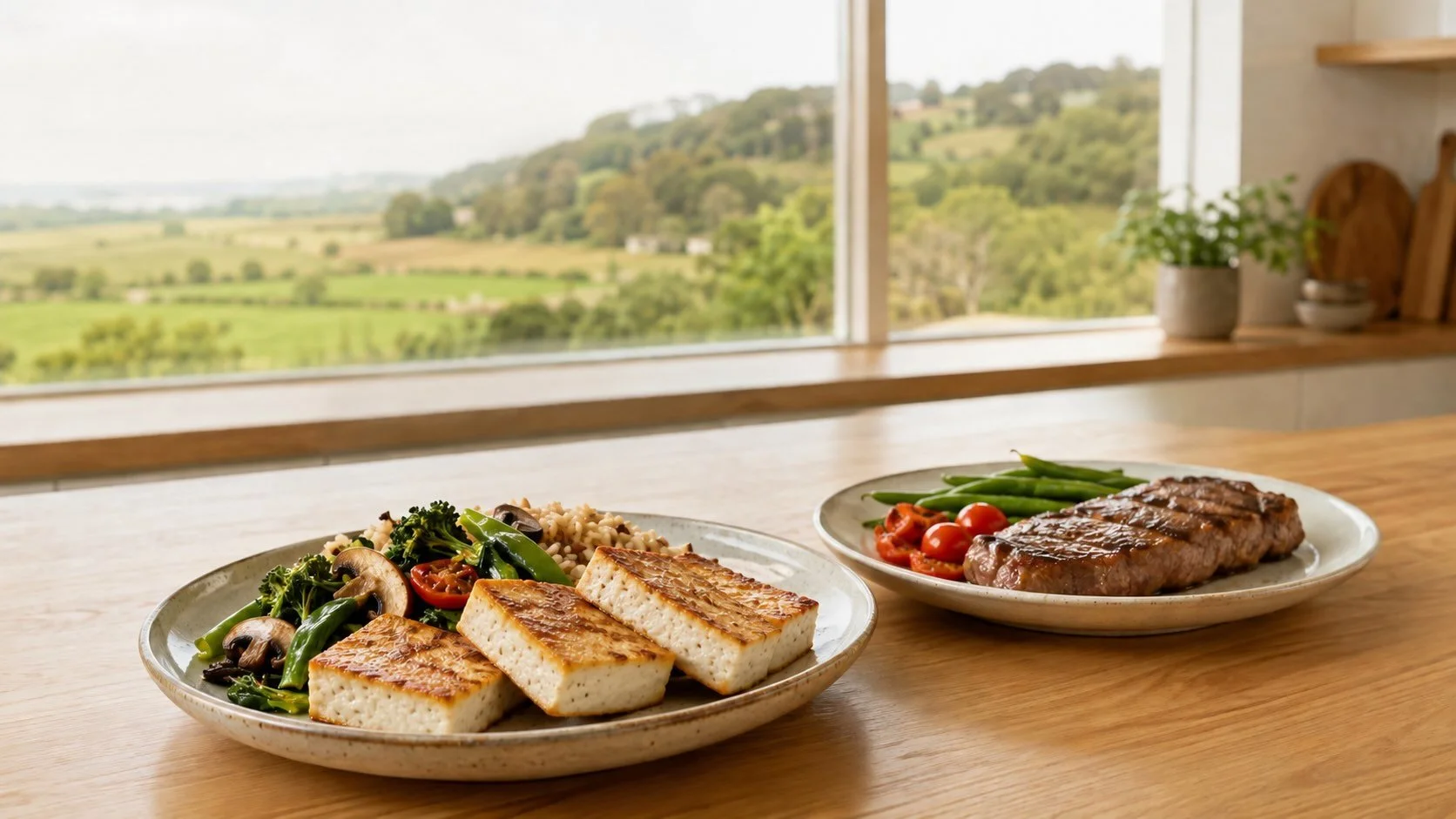
Food choices influence greenhouse-gas emissions, land demand, freshwater pressure and water pollution. Tofu is often presented as a sustainable alternative to meat, but the comparison is not as simple as “plants good, animals bad”. Tofu still requires farming and processing; meat footprints vary by type, and production methods matter on both sides.
Even so, the evidence is clear: tofu usually has a substantially lower environmental impact than meat—especially beef. Understanding why is more useful than repeating one carbon-footprint number.
How Can Tofu and Meat Be Compared Fairly?
A kilogram of tofu does not provide the same protein or energy as a kilogram of meat. For protein-rich foods, impact per 100 grams of protein is often more informative, although no unit captures nutrition perfectly.
The strongest global benchmark remains Joseph Poore and Thomas Nemecek’s 2018 Science study. It harmonised life-cycle data from about 38,700 farms and associated supply chains across 119 countries, measuring emissions, land use, freshwater withdrawals, acidification and eutrophication.
These are global averages, not predictions for every product. Farm location, feed, yields, energy and waste management can move an individual product above or below its category average. Labels such as “tofu” and “beef” cannot describe every supply chain, but the differences are large enough to reveal a clear overall pattern. Better production may narrow the gap; it rarely reverses the ranking completely.
Climate: Beef Creates the Largest Divide
Producing 100 grams of protein averages about 50 kilograms of carbon-dioxide equivalents for beef from dedicated herds, compared with about 2 kilograms for tofu—roughly one twenty-fifth as much. Pork averages about 7.6 kilograms and poultry 5.7 kilograms on the same basis, so tofu retains a meaningful advantage over both.
Beef’s footprint is high because cattle emit methane while digesting food. Feed, manure, fertiliser and land clearing add emissions. The UN Food and Agriculture Organization estimates that cattle raised for meat and milk contribute 62% of livestock-system emissions worldwide.
Tofu has no enteric methane stage. Its footprint comes mainly from soybean farming, transport, heat, electricity, packaging and refrigeration. Energy sources and factory efficiency matter, but processing does not erase tofu’s climate advantage.
Land: Tofu Does More With Less
Land creates an even wider divide. For 100 grams of protein, global average land use is about 164 square metre-years for beef from dedicated herds and 2.2 for tofu. That makes beef’s average land demand approximately 75 times greater. Pork uses about five times and poultry about three times as much land as tofu on the same basis.
Livestock needs pasture or housing as well as land for feed. This increases habitat and biodiversity pressure where agriculture replaces natural ecosystems. Lower demand also allows spared land to recover vegetation and store carbon, provided it is protected or restored.
Soy, Animal Feed and Deforestation
Soy farming can contribute to deforestation and the conversion of species-rich savannahs. That concern is real, but blaming tofu for the soy industry confuses the crop with its dominant uses.
Most soybeans are crushed into oil and protein-rich meal, which is overwhelmingly used in animal feed. Tofu, tempeh, soy milk and other direct soy foods account for a small share of demand. Exact percentages depend on how the oil and meal co-products are allocated, but global commodity flows show that livestock feed—not tofu—is soy’s central connection to meat production.
Where information is available, favour brands using deforestation- and conversion-free soy, transparent sourcing and credible certification. Replacing meat with tofu generally reduces total land pressure rather than shifting an equal burden.
Water: One Number Does Not Tell the Story
Global averages show that producing 100 grams of protein involves about 93 litres of freshwater withdrawals for tofu, compared with about 728 litres for beef. This is a substantial difference, but it is not a universal percentage saving.
Water figures can measure different things. Some estimates combine rain falling on crops, irrigation drawn from rivers or aquifers, and water associated with pollution. Freshwater-withdrawal data focus on water taken from surface and groundwater sources. Neither approach shows the whole impact on its own.
Location matters too: withdrawing a litre in a wet region is not equivalent to taking one from a stressed catchment. Scarcity-weighted freshwater use accounts for this local pressure. Tofu’s result varies with soybean irrigation, geography and factory water management, just as meat’s varies with feed production and farming systems. The useful conclusion is not that tofu is water-free, but that it generally compares favourably with beef while simplistic water-saving claims deserve caution.
Pollution, Waste and Packaging Still Matter
Fertiliser and manure can release nutrients into waterways, encouraging algal growth and oxygen loss—eutrophication. The global averages place tofu well below beef, pork and poultry per unit of protein, partly because feeding animals adds another stage.
Tofu production leaves fibre-rich okara and tofu whey. Okara can become food, feed or another product, but unmanaged waste can burden waterways. Efficient heating, cleaner electricity, water treatment, by-product recovery and better packaging can improve tofu’s footprint.
These limitations deserve attention. They do not, however, make tofu environmentally equivalent to meat.
What About Local, Grass-Fed or Regenerative Meat?
Some grazing systems support livelihoods, use land unsuitable for crops or provide ecological benefits. Better feed, animal health and manure management can lower livestock emissions.
However, “local” mainly shortens transport; it does not remove methane, feed or land requirements. Soil-carbon gains are variable, reversible and limited, so they should not automatically cancel continuing emissions.
Choosing better-produced meat may reduce impact; replacing a meat meal with tofu usually reduces it further.
The Most Useful Choice Is a Repeatable One
This is not an instruction for dietary perfection. Replacing beef offers the largest reduction; replacing pork or chicken still helps. What matters is finding a tofu meal enjoyable enough to become part of your routine.
Buy only what you will use and turn leftovers into another meal. Responsibly sourced soy and lower-impact packaging can refine the choice, but the largest benefit comes from using tofu in place of meat.
Final Takeaway
Tofu is not impact-free, and its footprint changes with soybean farming, energy, water treatment, packaging and transport. Meat production varies too. Yet life-cycle evidence shows that tofu typically has a far smaller climate and land footprint, while creating less nutrient pollution than meat—especially beef.
The value lies in possibility, not perfection. Each time tofu replaces meat, a meal asks less of the planet. Begin with a dish you enjoy, repeat it, and let one choice become part of something larger: a kinder, more sustainable food system.
