
Sous Vide Tofu Science – Is Low and Slow Cooking Worth It?
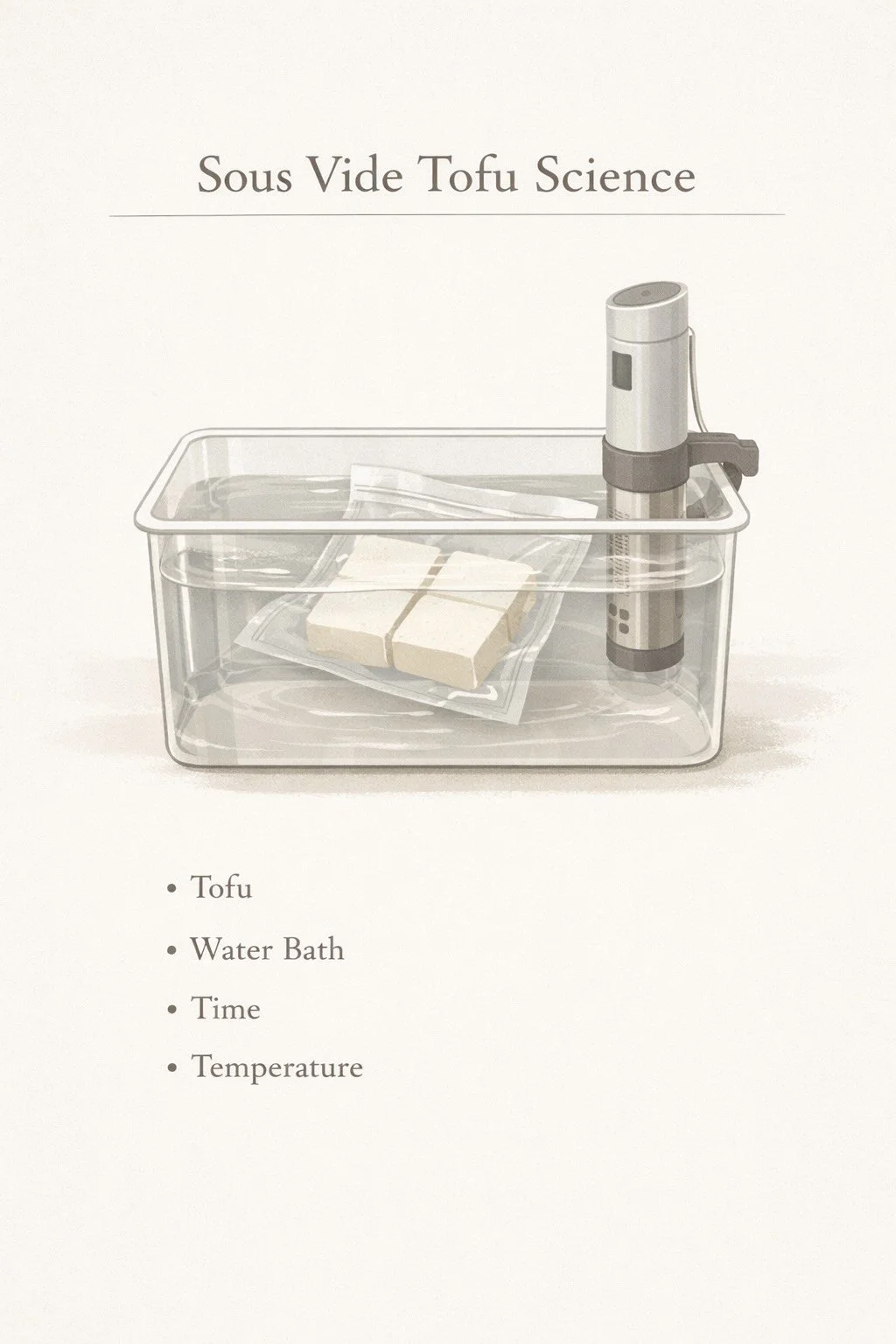
The Question Everyone Asks
Sous vide has a reputation for perfect texture.
So naturally, tofu gets pulled into the conversation.
But here’s the core problem:
Tofu is not a muscle fibre.
It doesn’t behave like meat under heat.
To understand whether sous vide tofu is “worth it”, we need to step away from hype and look at protein structure, water movement, and flavour transfer—the things that actually define tofu cooking.
What Sous Vide Is Designed to Do
Sous vide excels when an ingredient benefits from:
Slow collagen breakdown
Precise doneness control
Moisture retention inside dense muscle fibres
That’s why it works so well for meat.
Tofu, however, is already:
Fully cooked during production
Structurally set by coagulation
Saturated with water
Which immediately changes the equation.
Tofu’s Internal Structure (Why It Matters)
Tofu is a protein gel, not layered fibres.
Its structure is held together by:
Soy proteins (7S & 11S fractions)
Ionic or acid-set bonds
Trapped water within a sponge-like matrix
Heat doesn’t “tenderise” tofu.
It mainly causes water migration.
That single fact defines whether sous vide helps—or does nothing at all.
What Happens When You Sous Vide Tofu
1. Temperature: Too Gentle to Change Structure
Most sous vide recipes suggest 55–65°C.
At these temperatures:
Soy proteins do not denature further
No new bonds form
Texture remains fundamentally unchanged
You’re holding tofu at a temperature it’s already survived during manufacturing.
Result: no textural transformation.
2. Water Movement: The Hidden Issue
Low temperatures mean:
No evaporation
No surface drying
No internal pressure pushing water out
Instead of firming up, tofu often becomes:
Slightly more waterlogged
Softer at the edges
Harder to brown later
This is the opposite of what most people want.
3. Flavour Absorption: Overestimated
Vacuum sealing feels powerful—but flavour still moves by diffusion, not suction.
In tofu:
Marinades coat the surface
Penetration is shallow and slow
Oil molecules don’t travel inward
After hours in a bag, most flavour still sits on the outside.
When Sous Vide Does Make Sense for Tofu
Sous vide isn’t useless—it’s just niche.
Good Use Cases
Silken tofu for custards, savoury creams, or dessert bases
Gentle warming without agitation
Infusion holding before blending (not before searing)
In these contexts, sous vide offers:
Temperature stability
No curdling
Controlled softness
Poor Use Cases
Firm or extra-firm tofu
Any recipe requiring crispness
“Steak-style” tofu
Browning-first applications
Sous vide adds time—but not an advantage.
The Crispness Problem (Why It Always Fails)
Crisp tofu depends on one thing:
Surface dryness.
Sous vide guarantees the opposite.
After water-bath cooking, tofu must be:
Thoroughly dried
Pressed again
Reheated at high temperature
By the time you do that, sous vide has added zero net benefit.
Better Alternatives to Sous Vide
If your goal is texture and flavour, these methods outperform sous vide every time:
Pressing + Resting
Removes free water
Improves browning
Enhances marinade adhesion
Low-Temperature Oven Drying
120–140°C
Gradual moisture loss
Structure stays intact
Steam → Chill → Sear
Steam sets the structure evenly
Chilling firms the matrix
Searing becomes more effective
Each of these actually changes tofu behaviour.
Why Sous Vide Persists Anyway
Sous vide tofu is popular because:
It sounds technical
It feels chef-driven
It photographs well
But good cooking isn’t about complexity.
It’s about matching technique to ingredient physics.
The Verdict
Sous vide tofu is rarely worth it.
Not because it’s bad—but because tofu doesn’t benefit from what sous vide is designed to do.
Tofu improves with:
Water removal
Surface heat
Structural contrast
Not long baths.
Final Takeaway 🌱
Tofu doesn’t need precision temperature control.
It needs intention.
When you work with tofu’s structure instead of treating it like meat, flavour deepens, texture sharpens, and cooking becomes simpler—not slower.
Low and slow has its place.
Just not here.
