
When Tofu and Soy Sauce Fell Deeply in Flavour
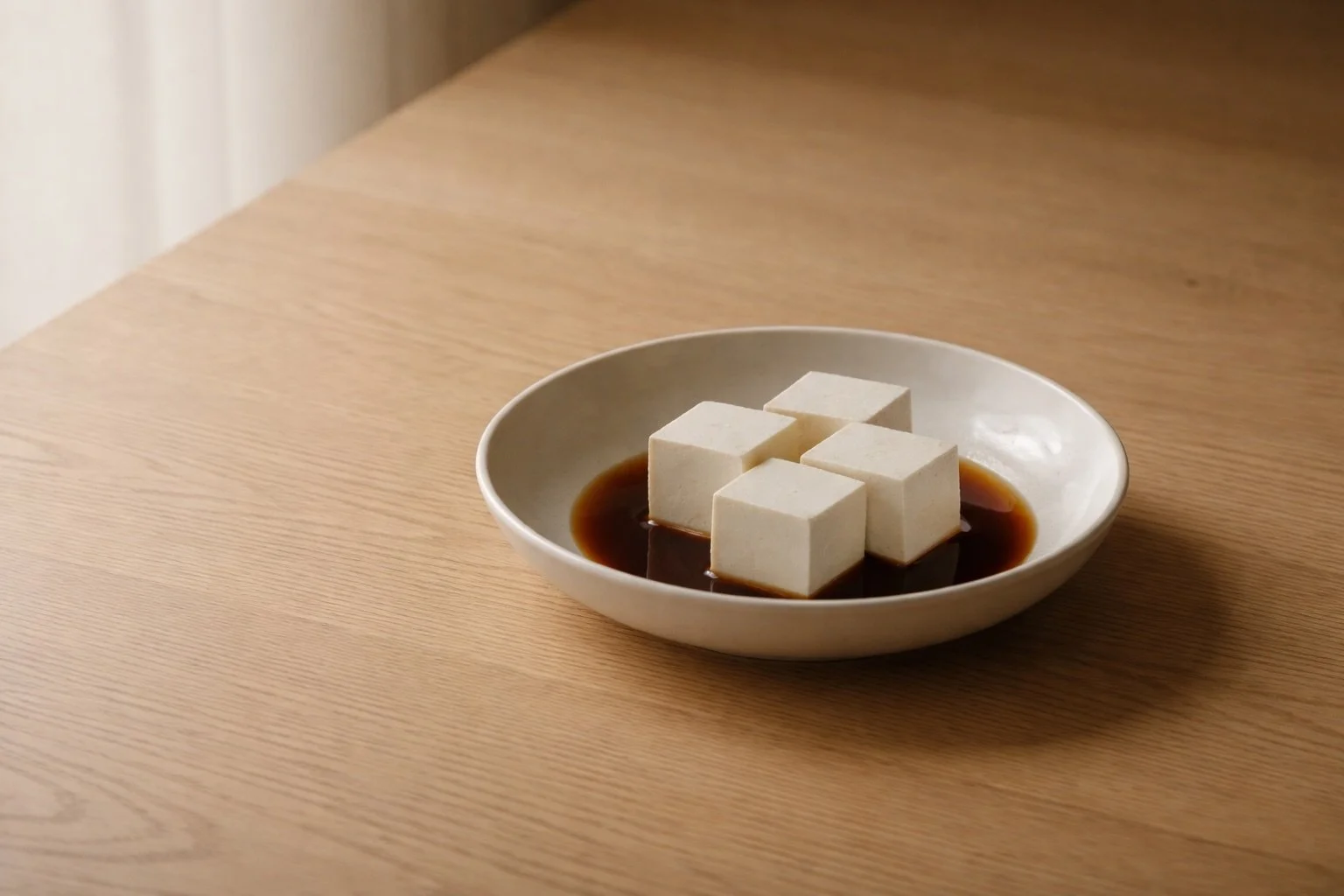
It didn’t happen loudly.
No fire. No spectacle.
Just a quiet meeting—one pale and still, the other dark and alive.
Tofu had always been misunderstood.
Called bland. Empty. A sponge.
But tofu was never empty.
It was complete—just waiting.
Soy sauce, on the other hand, carries history in every drop.
Fermented. Patient. Complex.
Where tofu was silent, soy sauce was a story.
And somehow, they were meant to meet.
Tofu: The Quiet One
Tofu doesn’t shout.
It doesn’t demand attention.
Because tofu is not a flavour—it’s a structure.
A protein–water gel.
A delicate network of soy proteins holding water in balance.
It doesn’t absorb the world like a sponge.
It interacts with it—on the surface, gently, precisely.
Tofu is the kind of presence that doesn’t change the room—but makes everything else more noticeable.
Soy Sauce: The One Who Carries Depth
Soy sauce arrives with weight.
Not heaviness—but depth.
It is the result of time:
Fermentation
Transformation
Patience
Inside it lives umami—the taste of amino acids, especially glutamates.
This is not just flavour.
This is a signal.
Soy sauce doesn’t just season.
It tells the palate:
“There is something here worth paying attention to.”
The First Meeting: Surface Contact
When soy sauce meets tofu, something subtle happens.
Not a flood.
Not absorption.
A bond at the surface.
Salt begins to move inward—slowly.
Aromatics stay near the exterior.
The outside changes first:
Slight tightening of the protein structure
Enhanced savouriness
A shift from neutral to defined
Tofu doesn’t become soy sauce.
It becomes more itself—but clearer.
Why This Works: The Science of Their Bond
This is not romance by chance.
It’s compatibility.
Tofu brings:
Water
Protein structure
Neutral baseline
Soy sauce brings:
Salt (enhances flavour perception)
Glutamates (umami depth)
Fermented complexity
Together, they form the simplest version of a complete flavour system:
Structure (tofu)
Depth (soy sauce)
Nothing extra.
Nothing forced.
Just alignment.
But Love Alone Isn’t Enough
Even the strongest pair needs balance.
Too much soy sauce—and the story becomes one note.
Too much tofu—and nothing is said.
This is where the world begins to open.
A third voice enters.
A squeeze of citrus → brightness
A drop of oil → carry
A touch of sweetness → softness
Now the relationship evolves.
From connection → to harmony.
From two → to a system.
What This Teaches Us About Cooking
This story is not about tofu and soy sauce.
Not really.
It’s about how flavour works.
You don’t need complexity to create depth.
You need contrast and complement.
Something that holds
Something that speaks
Tofu and soy sauce are one of the simplest expressions of this idea.
A reminder that:
Flavour is not built by adding more—but by choosing what belongs together.
How to Use This in Your Kitchen
Think in roles, not recipes.
Start here:
Tofu + soy sauce
Then ask:
What’s missing?
Add only what’s needed:
Brightness → vinegar, citrus
Carry → sesame oil, nut paste
Aroma → garlic, ginger, herbs
Keep it intentional.
Keep it quiet.
Let the ingredients speak.
Final Thought
Tofu never needed saving.
It just needed the right companion.
And soy sauce was never overpowering—just waiting to be understood.
Together, they show us something simple, but powerful:
When ingredients meet with purpose, even the quietest ones can create something unforgettable.
