
Agedashi Tofu with Dashi Reduction and Shaved Daikon
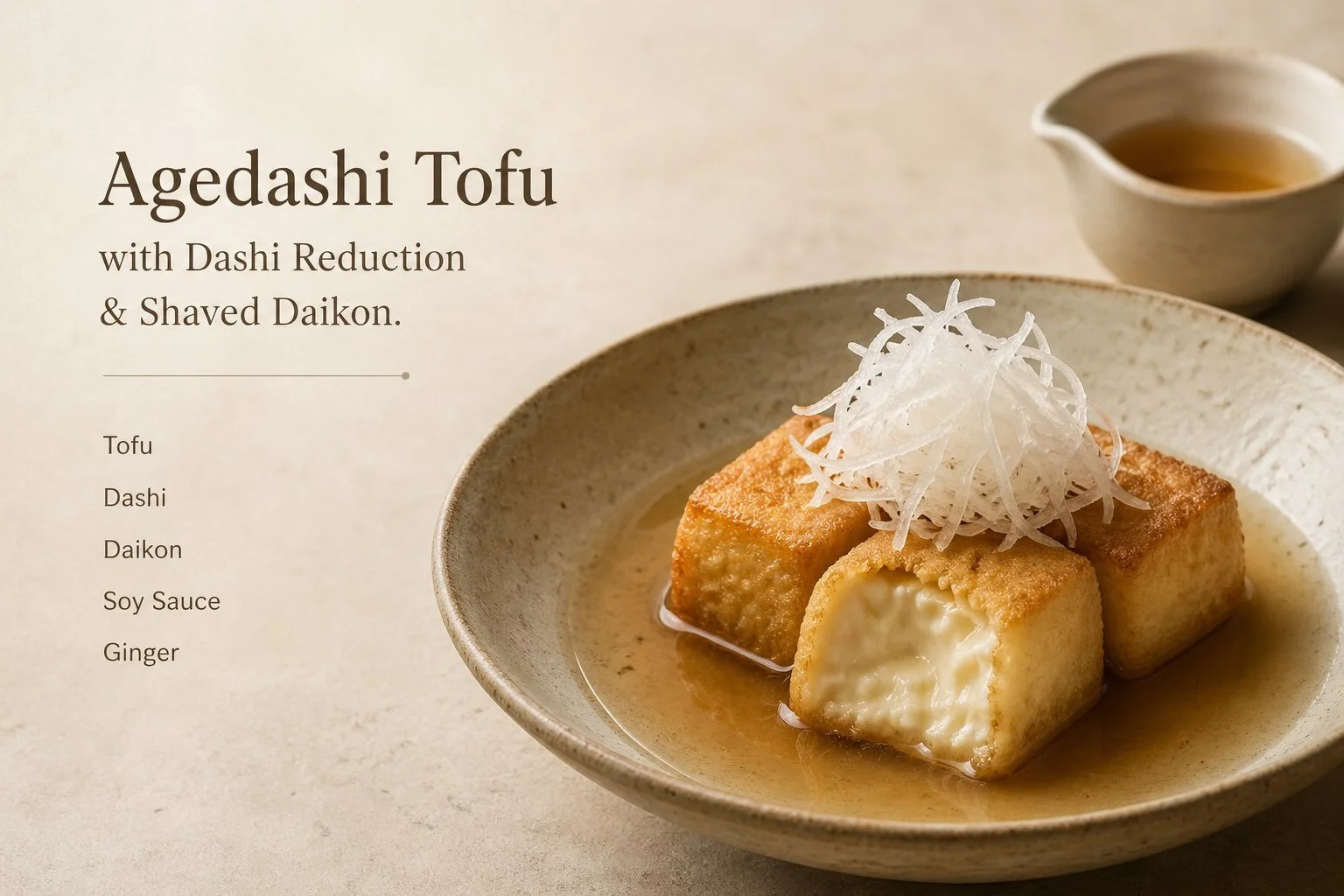
Mastery of texture contrast: crisp outside, molten inside.
How to Use This Dish
This is not a fixed recipe.
It is a structure you can return to.
The focus is not on measurements, but on understanding:
how moisture behaves
how heat transforms
how balance is maintained
Once understood, the dish becomes adaptable without losing its identity.
Dish Identity
This is a contrast-driven tofu dish.
A crisp outer layer holds a soft, custard-like interior, supported by a light, umami-forward broth.
It is not:
a heavy fried dish
a soup
a sauce-dominant plate
The experience is intentional:
Crisp → soft → clean finish
Culinary Roots & Modern Context
Agedashi tofu originates from Japanese cuisine, where lightly fried tofu is served in a delicate dashi broth.
The traditional structure prioritises:
clarity over intensity
lightness over richness
texture over volume
This version keeps that foundation but uses a gentle dashi reduction—not to thicken, but to slightly concentrate flavour while preserving clarity.
Ingredient Logic
Each element has a role.
Structure (Protein Base)
Firm tofu
→ Holds shape under heat while softening internally
Body (Liquid Depth)
Dashi (kombu + shiitake or plant-based variation)
→ Provides umami with lightness and clarity
Brightness (Balance Layer)
Shaved daikon
→ Lightens the dish and subtly helps break down richness
Aroma (Finish)
Soy sauce and ginger
→ Adds lift, warmth, and direction
Structural Goal (What Success Looks Like)
Thin, crisp outer layer
Soft, custard-like interior that holds shape
Broth that lightly coats, not floods
A clean, lifted finish
The dish should feel light, even though it is fried.
Cooking Logic
The sequence defines the result.
Moisture comes first.
Tofu must be properly dried before it meets heat.
As long as water remains, the surface cannot brown.
Once the surface dries, the temperature can rise beyond 100°C, allowing browning to begin.
The exterior sets quickly under heat.
The interior softens gently through retained moisture.
The broth is introduced at the end.
This preserves contrast rather than dissolving it.
The daikon remains raw.
It brings freshness and resets the dish.
Science Moment
Tofu is a protein–water gel, not a sponge.
When fried:
surface water evaporates
temperature rises beyond 100°C
the Maillard reaction (140–165°C) creates browning and crispness
Inside:
water remains trapped
the protein structure softens without collapsing
Dashi contributes another layer:
Glutamates (from kombu) and nucleotides (from shiitake) work together to amplify savoury perception.
When reducing dashi, the goal is gentle concentration, not aggressive boiling—excess heat can dull clarity and introduce unwanted texture.
This is how texture is shaped—not by recipe, but by understanding.
Flavour Architecture
Dominant
Umami depth from dashi
Supporting
Salt from soy sauce
Aromatic
Ginger warmth
Restrained
Daikon freshness
The dish is built on clarity, not intensity.
Adaptation Window
You can adapt:
coating (starch or light flour)
dashi strength
subtle aromatics (scallions, citrus)
You should not:
skip drying the tofu
over-reduce or heavily thicken the broth
overload toppings
The structure depends on restraint.
Common Failures & What They Mean
Soggy tofu
→ moisture not removed or oil temperature too low
No crisp crust
→ surface never exceeded 100°C
Dense interior
→ overcooked or incorrect tofu type
Flat flavour
→ diluted dashi or low-quality ingredients
When & How to Serve
Serve immediately after frying.
Pour the broth just before serving to preserve contrast.
Serve warm, not overly hot.
Best as a starter or a light, focused dish.
Timing defines the experience—contrast fades quickly.
Closing Reflection 🌱
Agedashi tofu shows what tofu truly is.
Not a substitute.
Not a blank canvas.
But a structure that responds to care.
When you understand moisture, heat, and balance, you stop following recipes—and start shaping texture itself.
