
Baked Tofu 101: Master Texture Through Time and Temperature
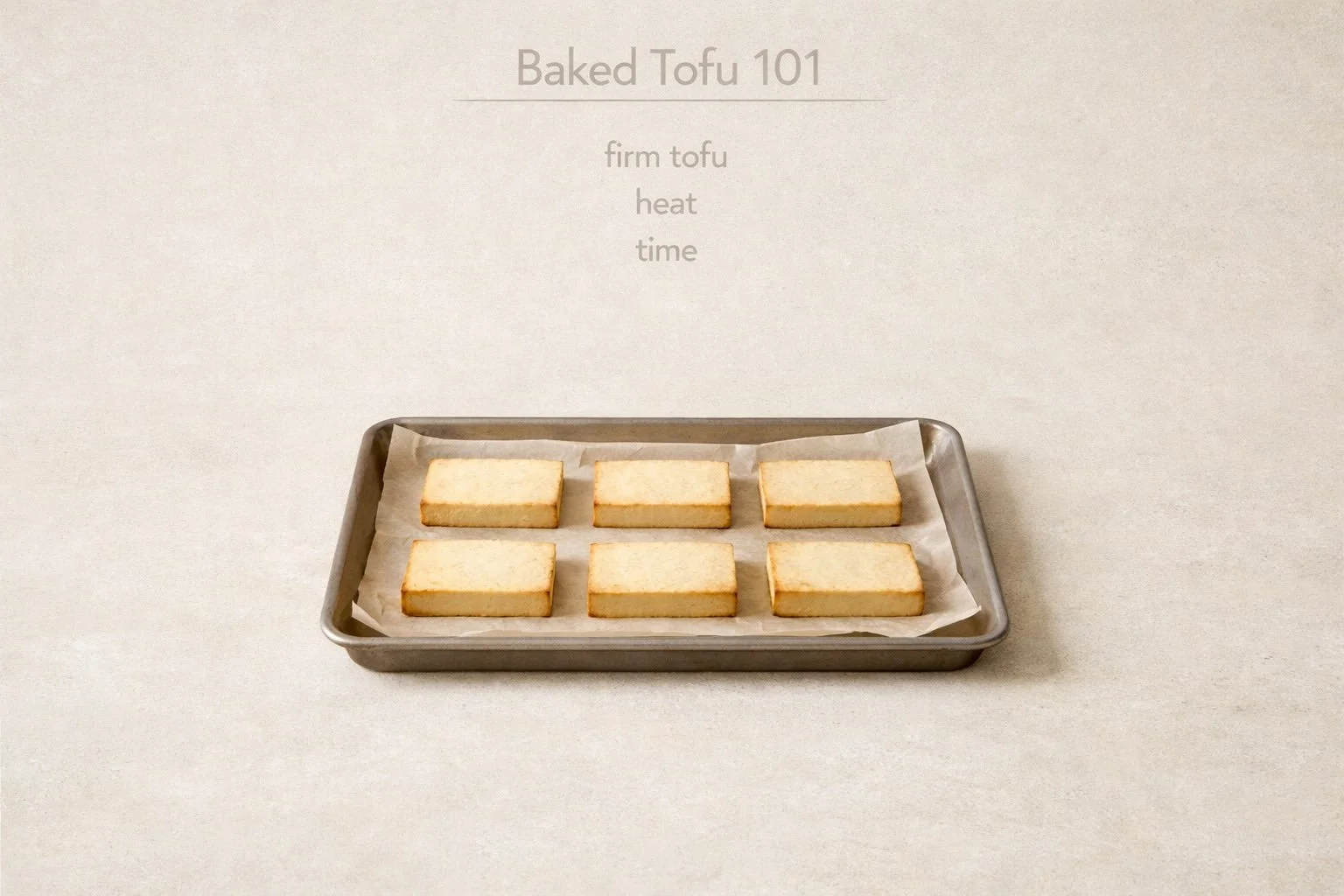
Why Baked Tofu Deserves Respect
Baked tofu often gets dismissed as dry, boring, or meal-prep food.
That reputation isn’t tofu’s fault—it’s technique.
Unlike pan-frying, baking works slowly. It removes moisture gradually, allowing tofu’s internal protein network to tighten, stabilise, and brown without violent heat. When done right, baking produces tofu that’s:
firm but not tough
deeply savoury
evenly cooked from edge to centre
structurally reliable for bowls, wraps, salads, and meal prep
Baking isn’t a shortcut. It’s a controlled environment—and control is where texture lives.
The Material Reality of Tofu (Why Baking Works)
Tofu is a protein-water gel: a three-dimensional soy protein network holding water in place.
When exposed to heat, two things happen simultaneously:
Water evaporates from the surface
Proteins tighten and stabilise as moisture leaves
Baking slows both processes. That’s its advantage.
Instead of forcing moisture out (like pressing or frying), the oven lets tofu re-balance itself—drying gradually while maintaining internal integrity.
Think of baked tofu not as “cooked tofu,” but as set tofu.
Time Is the Primary Ingredient
Most baked tofu fails because it’s rushed.
Short Bake (15–20 minutes)
Surface dries slightly
Interior remains soft and custardy
Minimal browning
Best for sauces added after baking
Medium Bake (25–30 minutes)
Balanced moisture loss
Edges begin to firm
Interior becomes sliceable
Ideal for bowls and salads
Long Bake (35–45 minutes)
Deep dehydration at the edges
Dense, chewy centre
Strong savoury concentration
Best for bold marinades or reheating
👉 Texture isn’t binary.
Time lets you choose where on the soft-to-chewy spectrum you land.
Temperature Sets the Rules
Temperature determines how much moisture leaves tofu.
Low Oven (160–170°C)
Gentle evaporation
Even internal setting
Pale colour
Best for soft, custard-like tofu
Moderate Oven (180–190°C)
Balanced moisture loss
Controlled browning
Reliable structure
The “default” baked tofu zone
High Oven (200–220°C)
Rapid surface dehydration
Aggressive browning
Risk of toughness if rushed
Best used after the structure is set
💡 Key insight:
High heat without time = dry tofu.
Time without enough heat = pale tofu.
You need both—but in the right order.
Pressing: Optional, Not Mandatory
Pressing removes free water, not bound water.
For baking:
Light pressing (10–15 minutes) improves surface browning
Heavy pressing can collapse the internal structure
No pressing works perfectly well for longer bakes
If you bake long enough, the oven becomes your press.
Cut Size Is Texture Control
Thickness determines how heat penetrates.
Thin slabs (1–1.5 cm): faster drying, firmer texture
Medium slabs (2–2.5 cm): balanced interior and edge
Cubes: uneven moisture loss, best flipped midway
Uniformity matters more than shape.
Inconsistent cuts = inconsistent texture.
The Browning Myth (And How to Actually Achieve It)
Browning doesn’t come from marinades alone.
It comes from dry surfaces reaching high enough temperatures.
To encourage browning:
Oil lightly after surface moisture evaporates
Flip once moisture release slows
Finish with a brief high-heat phase if needed
Sugar and sauces belong after the structure is set, not before.
Common Baked Tofu Mistakes
Baking too hot, too fast
High heat before moisture has time to escape leads to toughness, not browning.Expecting crispiness without dehydration
Browning only happens once surface water is gone. Heat alone isn’t enough.Over-marinating before baking
Wet surfaces delay dehydration and limit browning. Flavour belongs on the surface after structure sets.Cutting uneven pieces
Inconsistent thickness causes uneven moisture loss and unpredictable texture.Trapping steam after baking
Leaving tofu on a solid tray, stacking pieces, or covering them allows steam to rehydrate the surface and soften the edges.
What to do instead:
Let baked tofu cool briefly in open air—ideally on a wire rack—so surface steam can dissipate and the exterior stays firm.
When to Choose Baking Over Frying
Baked tofu shines when you want:
consistency
batch cooking
structural reliability
neutral savoury depth
reheatable texture
Frying is expressive. Baking is a discipline.
Both have a place—but baking rewards patience.
Final Takeaway
Baked tofu isn’t about flavour hacks or clever sauces.
It’s about respecting time and temperature.
Once you understand how tofu releases moisture, sets structure, and browns on its own terms, baking stops being disappointing—and starts becoming dependable.
Master that, and tofu becomes something you can trust.
Quietly. Confidently. Every time. 🌱
