
The Science Behind Nutritional Yeast – A Vegan Umami Bomb
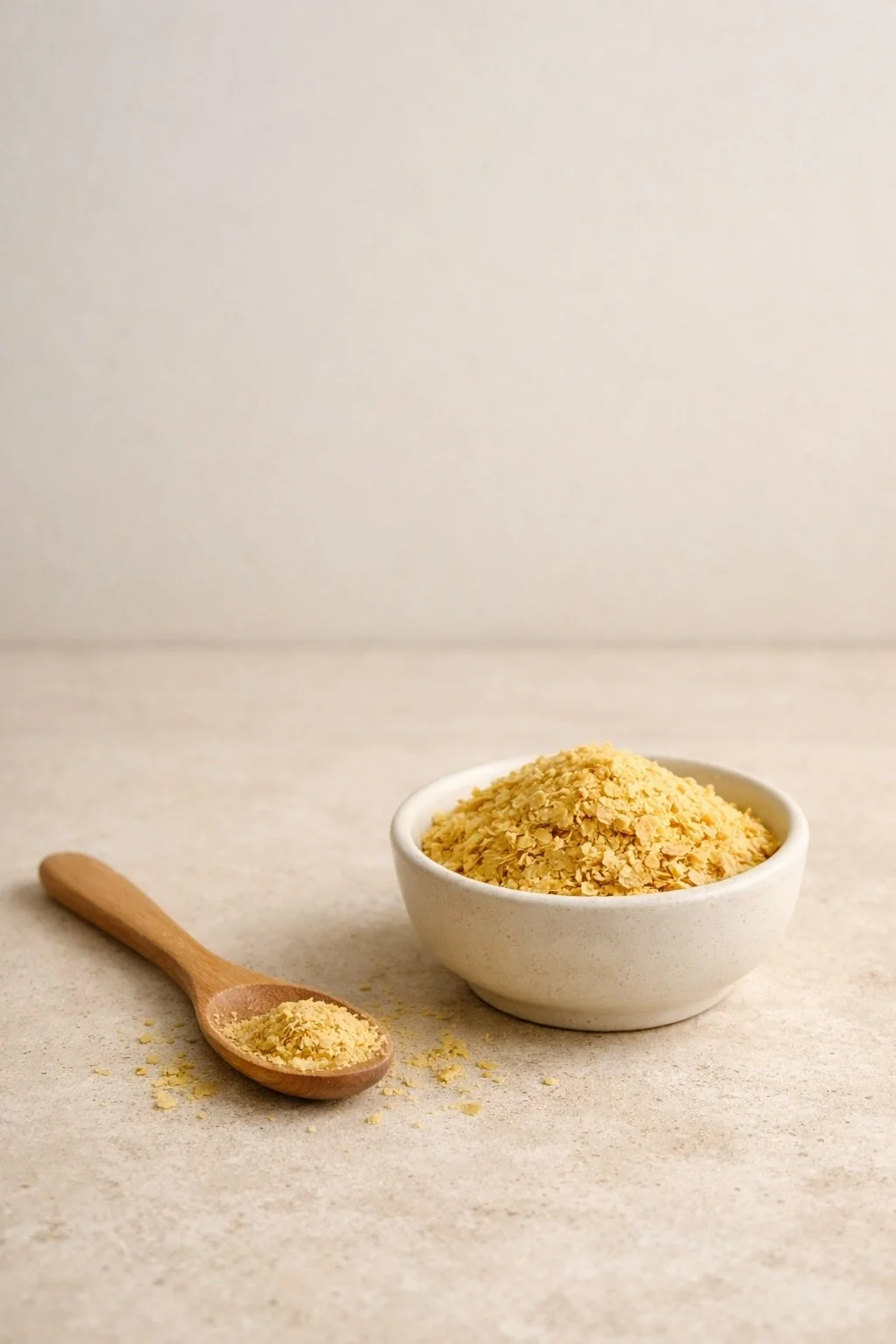
Why Nutritional Yeast Tastes So Good
Nutritional yeast (often called “nooch”) has earned a permanent place in plant-based kitchens. It’s scattered over popcorn, stirred into sauces, folded into tofu scrambles—and often responsible for that quiet moment of surprise when a dish tastes deeper than expected.
That satisfaction isn’t accidental.
It’s biochemical.
Nutritional yeast delivers umami: the same fundamental taste that gives mushrooms, aged cheeses, and long-simmered broths their savoury pull. What makes it unique is how efficiently it delivers this signal—without animal products, fermentation funk, or long cooking times.
To understand why it works so reliably, we need to look at what umami actually is.
Umami: The Fifth Taste, Built From Molecules
Umami perception is triggered when taste receptors detect free glutamates alongside specific ribonucleotides. When these compounds appear together, they don’t just add flavour—they amplify each other.
Nutritional yeast naturally contains both:
Free glutamic acid is responsible for savouriness
5′-ribonucleotides (notably IMP and GMP), which intensify the umami signal
When consumed together, these compounds bind to the tongue’s umami receptors and produce a flavour response far stronger than either could alone.
This explains why nutritional yeast tastes complex even in small amounts.
It isn’t salty.
It isn’t cheesy.
It’s structurally savoury.
How Nutritional Yeast Is Made
Despite the name, nutritional yeast is inactive yeast. It won’t ferment, rise, or multiply.
It begins life as Saccharomyces cerevisiae—the same species used in baking and brewing—but is cultivated specifically for flavour and nutrition. After growth on a sugar-rich medium, it is gently heated to deactivate it, then washed, dried, and flaked.
This deactivation step is crucial. It preserves the yeast’s cellular structure while leaving behind the amino acids and nucleotides responsible for its savoury profile. What remains is not a living organism, but a stable, flavour-dense ingredient.
That’s why nutritional yeast behaves more like a seasoning than a ferment.
Why It Works So Well in Plant-Based Cooking
Plant-based dishes often lack one thing by default: background savouriness.
Without collagen, animal fats, or long protein breakdown, depth must be built intentionally. Nutritional yeast excels here because it adds umami without changing a dish’s structure.
It contributes:
savoury backbone without oil
complexity without long cooking
balance without acidity or sweetness
Used well, it anchors flavour quietly.
Used poorly, it overwhelms.
Understanding its role makes the difference.
Nutritional Yeast and Tofu: A Natural Fit
Tofu is a protein–water gel. Its flavour is subtle, and its texture responds best to gentle layering rather than aggressive seasoning.
Nutritional yeast complements tofu because:
its fine particles dissolve into surface moisture
umami compounds bind well to soy proteins
it enhances savouriness without masking texture
In tofu scrambles, it integrates into the protein matrix early.
On baked or pan-seared tofu, it adheres to the surface, reinforcing crust flavour without encouraging steaming.
In both cases, it works with structure—not against it.
Heat, Timing, and Nutritional Limits
Nutritional yeast is remarkably stable from a flavour perspective. Its savoury compounds tolerate moderate heat well and perform best below high frying temperatures.
However, nutrition and flavour don’t always share the same limits.
Many brands are fortified with vitamin B₁₂, a micronutrient that is sensitive to:
prolonged high heat
highly acidic environments
While umami flavour remains intact, extended boiling or simmering—especially in tomato-based sauces—can reduce B₁₂ availability over time.
If you rely on nutritional yeast as a B₁₂ source, timing matters.
Adding it late preserves more than just flavour.
Common Mistakes (and Why They Happen)
Using too much
Nutritional yeast isn’t cheese. Excess flattens flavour and introduces dryness.
Expecting melt or stretch
It provides savouriness, not structure. Creaminess requires emulsification.
Cooking it aggressively
High heat can dull aromatic compounds and compromise fortified nutrients without improving flavour.
These aren’t failures of the ingredient—they’re mismatches of expectation.
How to Use It Intentionally
Think of nutritional yeast as a flavour amplifier, not a topping.
Use it to:
reinforce savoury notes in tofu and legumes
round out acidic sauces
replace background umami lost when animal products are removed
Its strength lies in restraint.
Final Takeaway: Umami Without Imitation
Nutritional yeast doesn’t succeed by pretending to be cheese.
It succeeds by understanding how savouriness actually works.
When you treat it as a system—respecting structure, heat, and timing—it becomes one of the most reliable tools in plant-based cooking.
Not louder. Just deeper. 🌱✨
