
Soy Milk vs Dairy: The Truth Behind the Bias
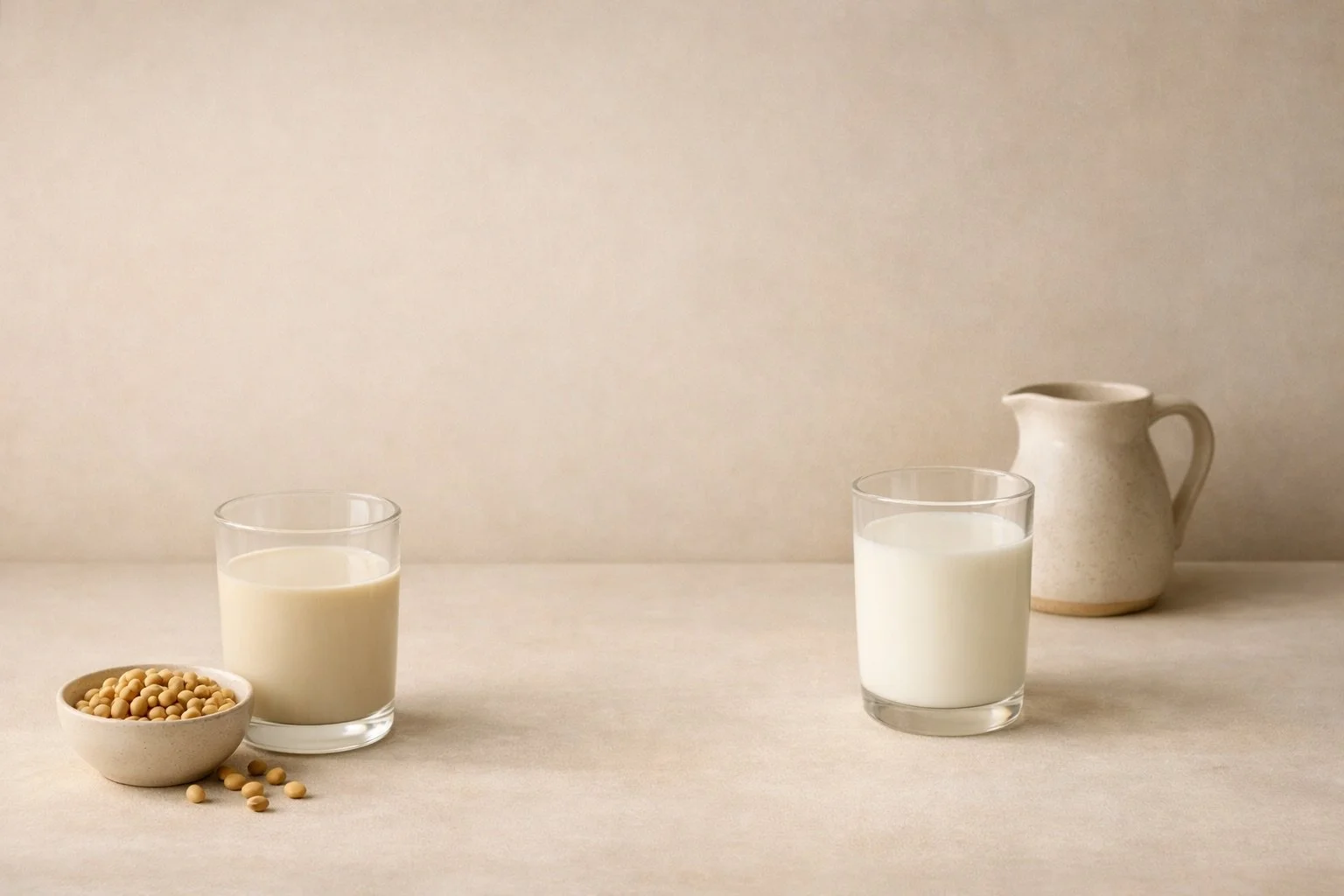
Why This Conversation Exists
Soy milk didn’t become controversial by accident.
It became inconvenient.
For an ingredient that has nourished cultures for centuries, its sudden framing as “problematic” tells us less about soy—and more about the systems around it.
This isn’t about choosing sides.
It’s about understanding how perception is shaped.
What Soy Milk Actually Is
Soy milk is one of the simplest plant-based foods:
Soaked soybeans
Ground with water
Heated and strained
That’s it.
At a molecular level, it’s a suspension of soy proteins (glycinin and β-conglycinin), fats, and carbohydrates—remarkably balanced for a plant food.
Unlike many modern alternatives, it isn’t engineered to imitate something else.
It exists on its own terms.
A History That Was Never the Problem
Long before modern debates, soy milk was already embedded in daily life across East Asia.
In China, it was consumed fresh alongside breakfast
In Japan, it became part of temple cuisine
Across Southeast Asia, it appeared both sweet and savoury
It wasn’t marketed.
It was simply used.
No one questioned whether it was “natural”.
Because it was.
When Perception Shifted
The tension around soy didn’t begin with science.
It began with competition.
As plant-based options entered Western markets, dairy was no longer the default—it had alternatives.
And with alternatives comes pressure.
Over time, a pattern emerged:
Soy framed as “unnatural”
Soy linked to hormonal fear
Soy described as “processed”
Not all of these claims came from bad science.
But many were amplified far beyond what the evidence supports.
The Hormone Myth, Quietly Revisited
One of the most persistent narratives:
“Soy disrupts hormones.”
The reality is more precise.
Soy contains isoflavones, a class of plant compounds sometimes called phytoestrogens.
But:
They are structurally similar, not identical, to human oestrogen
Their effect is weak and selective
In many cases, they act as modulators, not mimics
Large population studies consistently show:
No meaningful disruption to testosterone levels in men
No harmful effects on general hormonal health
In traditional diets where soy intake is high, these concerns never emerged as a cultural issue.
Because the body understands context.
And dosage matters.
“Processed” — A Convenient Word
Soy milk is often criticised as “processed”.
But processing is not inherently negative.
It depends on what is done—and why.
Consider:
Soaking → softens beans
Grinding → releases nutrients
Heating → removes anti-nutritional factors
Straining → improves texture
These are not industrial shortcuts.
They are functional transformations.
The same logic applies to:
Bread
Cheese
Olive oil
Processing, in itself, is not the problem.
It’s the intent behind it.
Nutritional Perspective, Without Noise
When stripped of marketing, soy milk stands quietly strong:
Complete protein (all essential amino acids)
Naturally low in saturated fat
Free from cholesterol
Often fortified with calcium and B12
Dairy, on the other hand, offers:
High calcium (naturally occurring)
Protein and fat (varies by type)
This isn’t a battle.
It’s a difference in structure.
Both can exist.
But only one has been systematically questioned.
Why the Resistance Feels So Persistent
Food isn’t just nutrition.
It’s identity.
For many, dairy represents:
Tradition
Familiarity
Cultural norm
Soy represents:
Change
Uncertainty
A shift away from what’s known
When something challenges the default, it rarely gets a neutral introduction.
It gets scrutiny.
Where Tofu Fits In
Soy milk doesn’t stand alone.
It becomes tofu.
And this is where its potential becomes visible.
The same proteins in soy milk can:
Form delicate silken tofu
Set into firm blocks
Transform into textures that absorb, crisp, and carry flavour
Tofu isn’t a substitute.
It’s a continuation.
A different expression of the same foundation.
So… Should You Choose One Over the Other?
That’s not the point.
The better question is:
Why was one positioned as normal—and the other as suspicious?
When you step back, the contrast becomes clearer:
One has centuries of quiet use
The other has decades of structured promotion
And yet, the narrative often runs in reverse.
Final Takeaway 🌱
Soy didn’t become controversial because it changed.
It became controversial because it entered a space that was never meant to be shared.
But when you strip everything back—marketing, headlines, assumptions—what remains is simple:
A bean.
Water.
Heat.
And a food that has always made sense.
Not as a replacement.
But as itself.
