
Tofu and the Planet: Lowering Your Carbon Footprint

Every meal has an environmental footprint. Growing ingredients, raising animals, processing food, refrigeration and cooking all require resources.
But the size of that impact varies enormously.
Replacing beef with tofu is one practical way to reduce a meal’s environmental cost without giving up protein, flavour or satisfaction. It does not require a perfect diet or an overnight transformation. It can begin with one dinner worth cooking again.
How Does Tofu Compare with Beef?
Comparing equal weights of tofu and beef can be misleading because they contain different amounts of water and protein. A fairer environmental comparison is based on producing the same amount of protein.
Global averages from the major life-cycle analysis by Joseph Poore and Thomas Nemecek show a striking difference:
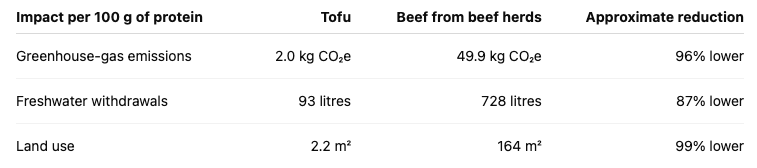
These are global averages, not fixed results for every producer. Farming practices, land-use change, irrigation, energy sources and tofu processing all influence the final footprint. Even with that variation, tofu generally places far less pressure on climate, freshwater and land than beef for an equivalent amount of protein.
Why Is Beef So Emissions-Intensive?
Beef’s footprint comes from several connected sources:
methane from cattle digestion;
methane and nitrous oxide from manure;
fertiliser and energy used to produce feed;
conversion of forests or native vegetation into pasture and cropland;
processing, refrigeration and transport.
Methane has a powerful warming effect over the near term, although it remains in the atmosphere for less time than carbon dioxide. The Food and Agriculture Organization of the United Nations (FAO) estimates that livestock systems produce about 32% of human-caused methane emissions, mainly through ruminant digestion and manure.
Tofu avoids enteric methane and takes a more direct route to protein. Instead of feeding crops to an animal that uses much of their energy for metabolism, movement and body maintenance, soybeans are processed directly into food for people.
Soybeans can also obtain nitrogen through bacteria in their root nodules, often reducing their direct need for synthetic nitrogen fertiliser. This does not make soy impact-free: land use, irrigation, other fertilisers, processing and transport still matter.
Tofu and beef are not nutritionally identical gram for gram. Protein content varies considerably between brands and between silken, firm and extra-firm tofu because each contains a different amount of water. Check the nutrition panel rather than assuming equal weights provide equal protein.
What About Soy and Deforestation?
Soy is often associated with deforestation, but how the crop is used matters.
Most soybeans are crushed into soybean meal and oil. The meal is used predominantly as livestock feed, while the oil enters food and industrial supply chains. Only a relatively small share becomes tofu, tempeh, edamame, soy milk and other foods eaten directly by people.
Cattle production adds land pressure through both grazing and feed production. Where expansion replaces forests or other native vegetation, it can release stored carbon, destroy habitat and reduce biodiversity.
Eating soy directly uses agricultural land more efficiently. When information is available, choose tofu made with locally grown, responsibly sourced or verified deforestation-free soybeans.
What Does “87% Less Water” Mean?
Freshwater withdrawal measures water taken from rivers, lakes and groundwater for irrigation and processing. It does not count every litre of rainfall that supports a crop.
Location matters too. Water withdrawn in a drought-stressed basin can have greater consequences than the same amount used in a water-abundant region.
The 87% figure is therefore a global average showing the scale of the difference—not a promise for every farm or tofu producer.
Turn the Evidence into Better Cooking
A lower-impact swap will last only if the food is satisfying. Instead of treating tofu as an imitation of meat, choose its texture and technique for the dish.
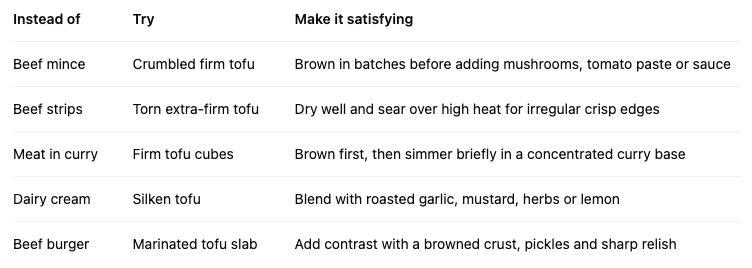
Press water-packed firm or extra-firm tofu only when excess moisture interferes with browning. Drying the surface is more important than forcing out every drop of internal water. Silken tofu should not be pressed, while dense vacuum-packed tofu usually needs only to be patted dry.
For professional kitchens, one batch of firm tofu can become seared portions, crumbles or fillings, while offcuts can be used in sauces or staff meals. At home, freeze leftover firm tofu for a chewier texture or blend remaining silken tofu into a dressing.
Reducing waste protects both tofu’s environmental advantage and the food budget.
Final Takeaway: Change Can Begin with Dinner
Tofu provides protein without enteric methane and with far less average pressure on climate, freshwater and land than beef. No food is impact-free, but the difference is large enough to matter.
You do not need to transform every meal overnight.
Begin with one well-cooked tofu dish. Make it crisp, deeply savoury and worth returning to.
A kinder, more sustainable food system is built through millions of ordinary decisions—and dinner is one place those decisions can begin.
