
Tofu Innovations: Shaping the Future of Plant-Based Foods
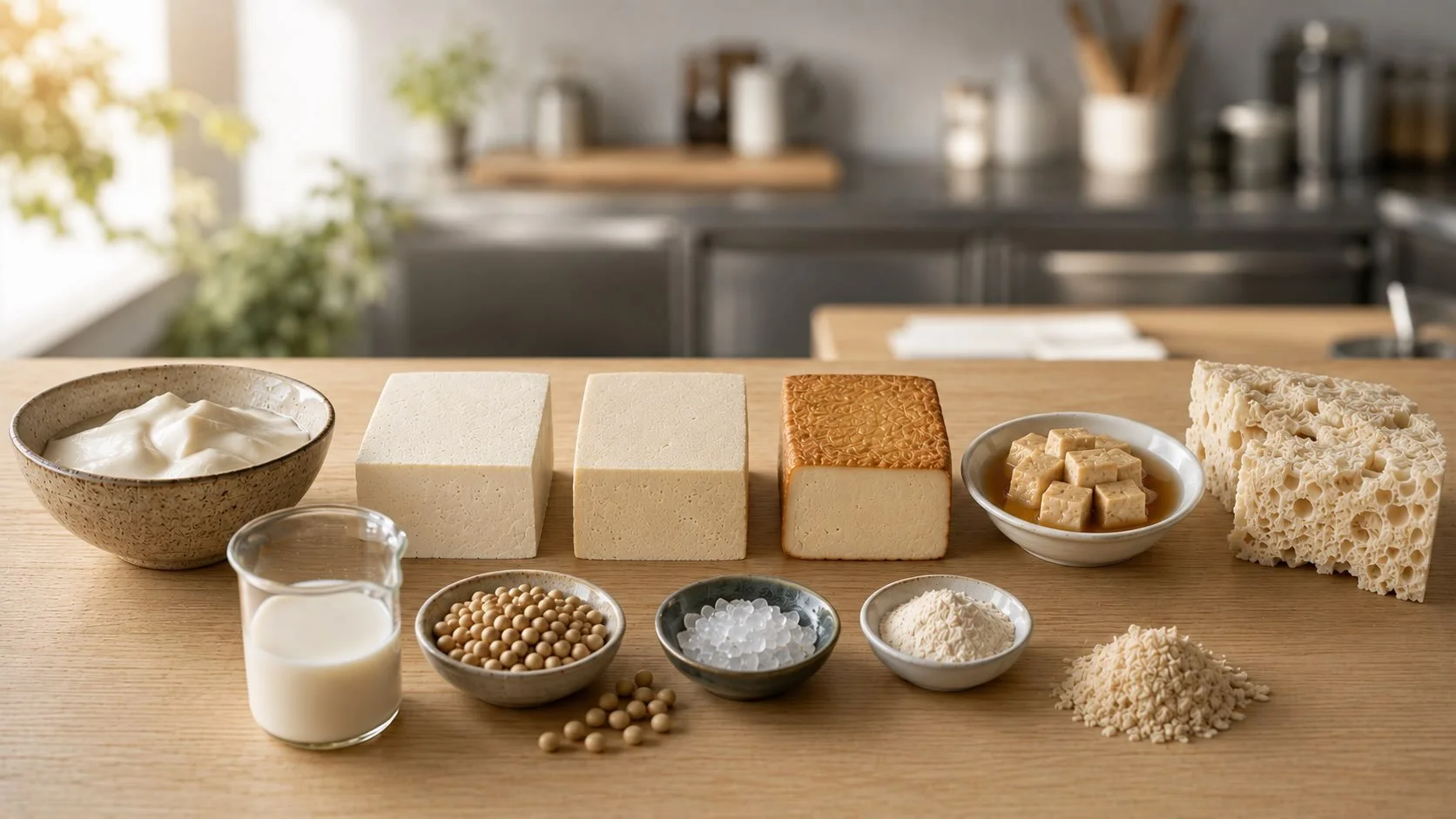
Tofu may be ancient, but it has never stopped evolving.
Its basic method remains simple: soybeans are soaked, ground with water, heated, filtered and coagulated before the curds are shaped or pressed. Yet small changes in soy concentration, temperature, coagulants, moisture and pressure can produce very different results.
Today, tofu makers, chefs and food scientists are using those variables more deliberately. The most meaningful innovations are not attempts to disguise tofu as something else. They are expanding its own textures, flavours, shelf life and culinary uses.
Tofu Is a Tunable Protein Gel
Tofu is a water-rich soy protein gel.
Heating unfolds the proteins in soy milk. A coagulant then encourages them to gather into a network that traps water, fat and dissolved solids. The way that network forms determines whether the tofu becomes smooth, springy, brittle, dense or custard-like.
Producers can adjust soy milk concentration, heating, coagulation time, pressing and final moisture. Concentrated soy milk generally produces denser tofu, while pressing removes water and strengthens the curd. Gentler coagulation tends to create finer, smoother gels.
This is why tofu texture is not simply a scale from soft to extra-firm. It reflects how the protein network was built.
High-protein tofu, for example, has a compact structure that holds together during grilling and stir-frying. Silken tofu forms a fine, continuous gel better suited to soups, sauces and desserts.
Coagulants Shape Texture
Coagulants do more than set soy milk. They influence texture, flavour and water retention.
Nigari, usually rich in magnesium chloride, acts relatively quickly and often produces tender, slightly elastic tofu.
Calcium sulfate, traditionally called gypsum, works more gradually and is widely used for dependable block tofu. It may also contribute calcium to the finished product.
Glucono delta-lactone, or GDL, works differently. Rather than linking proteins through mineral ions, it gradually acidifies soy milk. As the proteins lose electrical repulsion, they form a fine, continuous gel. This is why GDL is commonly used for very smooth silken tofu.
Commercial producers may combine coagulants to balance firmness, elasticity and moisture. The ingredient list can therefore offer a clue to texture, although soy concentration, heating and pressing also shape the final result.
Texture Innovation Beyond Pressing
Pressing is only one way to change tofu.
Freezing and thawing create one of the most dramatic transformations. As water inside tofu freezes, ice crystals expand and push apart the protein structure. After thawing, the melted ice drains away, leaving visible pores.
The tofu becomes chewier and more open. Those cavities hold broth and sauce through capillary action, making frozen tofu especially useful in braises, hotpots and strongly seasoned dishes.
Freezing rate matters too. Slower freezing usually creates larger ice crystals and more pronounced cavities, while faster freezing produces a finer pore structure.
Manufacturers are also developing denser, higher-protein and partially dehydrated tofus that resist crumbling, brown more readily and remain intact during longer cooking.
These changes affect far more than appearance. They alter how tofu responds to heat, movement and liquid.
Better Flavour Through Smoking and Fermentation
Innovation is also changing how tofu tastes.
Smoked tofu brings savoury depth and a firmer bite, while marinated and baked varieties reduce preparation time for quick meals.
Fermentation creates a deeper transformation. Microorganisms and enzymes break some soy proteins into smaller peptides and amino acids, softening the curd, increasing savouriness and creating new aromas.
Depending on the method, fermented tofu may become creamy, salty, pungent, crumbly or cheese-like. Traditional products such as Chinese fermented bean curd show how mild tofu can become an intensely flavoured condiment or ingredient.
These foods are not modern inventions. The innovation lies in how traditional processes are being refined, packaged and introduced to wider audiences.
More Value From Every Soybean
Tofu production leaves behind okara, the moist soybean pulp separated during soy milk filtration.
Okara contains fibre, residual protein and other soybean solids, but its high moisture makes it highly perishable. It has long been used in dishes such as Japanese unohana and as animal feed. Today, it is also being turned into baking ingredients, crackers, noodles and plant-based patties.
Drying and milling can make okara easier to store and use, although producers still need to manage energy use, flavour, texture and food safety.
Using okara more effectively does not remove every environmental cost of tofu production, but it can reduce waste and recover more value from each soybean.
Smarter Packaging and Preservation
Packaging innovation has changed how tofu is stored and distributed.
Aseptic silken tofu is heat-treated and sealed in sterile packaging, allowing it to remain shelf-stable until opened. Vacuum packaging reduces oxygen exposure, while high-pressure processing can reduce spoilage microorganisms after packaging without another strong heat treatment.
That may help preserve a fresher flavour and avoid some texture changes associated with thermal pasteurisation.
Packaging development is also moving towards lighter materials, reduced plastic use, recyclable formats and smaller portions that may reduce household waste. These changes may seem less exciting than a new texture, but they affect shelf life, transport and how much tofu is discarded before it is eaten.
What These Innovations Mean in the Kitchen
Not every new tofu product is automatically better.
A more useful question is:
What culinary problem does it solve?
Dense tofu may be excellent for skewers but too heavy for a delicate soup. Smoked tofu can add instant depth to a sandwich but overwhelm a subtle broth. Frozen tofu works beautifully in a braise but is unsuitable when a smooth texture is needed.
Rather than treating all tofu as interchangeable, choose it according to moisture, resistance to breaking, browning potential, ability to hold liquid and flavour intensity.
Beginners can improve their results simply by matching tofu to the cooking method. More experienced cooks can use these structural differences deliberately. Chefs can treat each style as a distinct ingredient rather than another version of the same block.
The Future of Tofu
The future of tofu is unlikely to depend on one dramatic invention.
It will come through better control of protein structure, more thoughtful coagulant use, refined fermentation, smarter preservation and more efficient use of okara.
A block once labelled simply “firm” may now be smoked for sandwiches, frozen for braises, fermented for intense umami or blended into a silky sauce.
The most meaningful innovations do not erase tofu’s identity. They reveal more of what it can become.
