
Tofu in Transition – How It Supports Your Plant-Based Path
Change rarely happens all at once.
For many people, eating more plant-based food is not a straight journey from one identity to another. It may begin with one meat-free dinner, a new ingredient in the shopping basket or the challenge of feeding people with different preferences.
That is where tofu can be especially helpful.
Tofu does not require you to become vegan, abandon familiar meals or master complicated recipes. It can fit into a stir-fry today, replace some mince next week and eventually become an ingredient you appreciate on its own terms.
There is no correct order and no finish line. Wherever you are on your plant-based path, tofu can meet a different need.
When Tofu Is Completely New
Silken, soft, firm, extra-firm, marinated and puffed tofu may sit near one another on the shelf, but they behave differently. Check both the label and the suggested uses rather than choosing by appearance alone.
For an easy first experience, try firm tofu or a pre-marinated firm variety. It is sturdy enough for stir-fries, tray bakes, wraps and curries without requiring delicate handling.
Begin with a familiar meal. You might crumble firm tofu into tacos, brown cubes before adding them to a curry or bake slices for a wrap.
Before frying or roasting, pat the surface dry. Excess moisture can slow browning and encourage sticking. However, do not assume every block needs pressing. Vacuum-packed, high-protein and already dense tofu may contain little removable water, while pressing soft or silken tofu can damage it.
The goal of your first tofu meal is not perfection. It is learning what one type of tofu can do.
When You Are Replacing Occasional Meals
You do not need to replace every animal-based ingredient at once. One regular tofu meal can create more lasting change than an ambitious shift that quickly becomes exhausting.
The most reliable approach is to choose tofu according to the job it needs to perform.
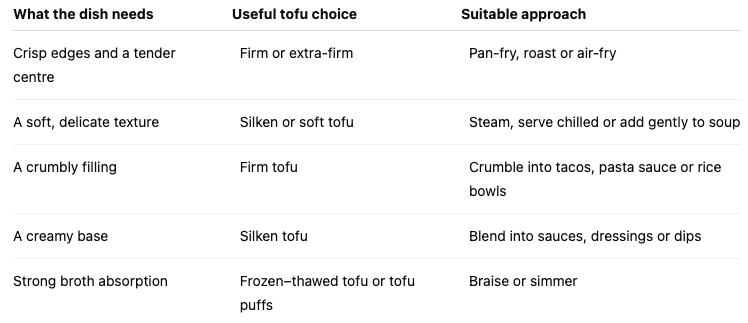
Firm tofu will not reproduce the fibres of grilled meat, but it can provide a deeply browned surface, smoky seasoning and a satisfying bite. Crumbled tofu is not identical to mince, but it can carry aromatics, spices and sauce through a familiar dish.
The aim is not always imitation. It is giving tofu a clear and enjoyable role in the meal.
When Tofu Becomes a Regular Protein
Once tofu enters your weekly routine, repetition can become the next obstacle. Cubes, sauce and rice may work for a while, but using the same format repeatedly can lead to tofu fatigue.
For greater variety, change more than the sauce. Change the shape, tofu style, cooking method or role on the plate.
Thin slabs create more browned surface. Larger cubes preserve a moist centre. Torn pieces develop irregular edges that catch glazes and seasonings. Silken tofu offers softness, while frozen–thawed tofu develops a more open structure suited to braising.
You can also explore beyond the standard white block. Tofu skin contributes layered chew; tofu puffs readily take up broth; smoked tofu supplies immediate savoury depth; and commercially prepared fermented tofu can be used sparingly as a potent seasoning.
Long before tofu became associated with modern plant-based eating, cooks across China, Japan, Korea, Vietnam and other parts of Asia valued its freshness, tenderness, absorbency and contrast with broths, vegetables, grains and fermented seasonings. These traditions reveal tofu as a diverse family of foods—not merely a substitute.
When You Are Feeding Mixed Preferences
Cooking for partners, children, flatmates or friends can make dietary change more complicated. One person may love tofu while another approaches it cautiously.
Shared-format meals can reduce that pressure. Rice bowls, noodle bowls, tacos, wraps and hotpot-style meals allow tofu, vegetables, sauces and other components to be assembled according to individual preferences.
In a mixed household, tofu and another protein can initially share the same vegetables, accompaniments and seasoning profile. Serving the sauce separately may also help people adjust the intensity for themselves.
Avoid hiding tofu or describing it apologetically. Instead, explain what it contributes: perhaps a crisp crust, a tender centre or a cooling contrast to a spicy dressing. Tofu does not need to convince everyone that it is something else. It needs a preparation that makes its own qualities appealing.
When You Begin Cooking Tofu as Tofu
As confidence grows, the question often changes from “How do I make tofu taste like meat?” to “Which tofu structure best suits this dish?”
Its water content, density, shape and surface condition all influence how it responds to heat. Browning depends heavily on a dry surface and good contact with a properly heated pan. Dense tofu generally absorbs little marinade deeply, so a seasoned coating, glaze or finishing sauce may deliver more flavour than hours of soaking.
Not every tofu dish should be crisp. Silken tofu can be especially compelling served cool beneath a warm aromatic dressing. Soft tofu provides delicate relief in a spicy stew. Firm tofu tolerates searing and grilling, while frozen–thawed tofu can carry broth through its altered internal structure.
Skilled tofu cooking is not about forcing every block through the same preparation. It is about matching structure, shape, seasoning and heat to the experience you want on the plate.
Nutrition Without Assumptions
Tofu provides high-quality plant protein and contains all nine essential amino acids. It can also contribute iron, while tofu set with calcium sulphate may supply a useful amount of calcium.
Products are not nutritionally identical. Protein, calcium, iron, sodium and energy content can vary with the coagulant, formulation and water content, so check the nutrition panel when a particular nutrient matters.
Pairing tofu with vitamin C-rich foods such as capsicum, broccoli, tomatoes or citrus can support the absorption of its non-haem iron. Tofu can be part of a balanced eating pattern, but it does not need to carry the whole diet by itself.
A Practical Environmental Step
Replacing some higher-impact animal-protein meals with tofu can generally reduce the land use and greenhouse-gas emissions associated with what we eat. Its exact footprint still depends on soybean farming, manufacturing, packaging and transport, so no product is impact-free.
The useful idea is not perfection, but direction. Small choices repeated over time can reshape shopping habits, household routines and food demand.
Common Mistakes That Make the Transition Harder
Choosing silken tofu for a method that requires firm pieces
Pressing every tofu variety automatically
Adding wet tofu to a crowded or insufficiently heated pan
Expecting marinade to penetrate deeply into dense tofu
Using the same cubes and sauce until boredom sets in
Assuming crispness is the only sign of well-cooked tofu
Final Takeaway
Tofu does not ask you to change everything at once.
It can begin as a convenient ingredient in a familiar dinner, become a reliable weekly protein and eventually open the door to an entire world of textures, traditions and techniques.
The most important transition may not be from meat to tofu. It may be from seeing tofu as a compromise to understanding what it genuinely brings: nourishment, adaptability, culinary possibility and a practical way to make some meals kinder and more sustainable.
A kinder world is rarely built in one leap.
It is built through choices we can enjoy—and choose again.
