
Why Moisture Control Is Everything in Tofu Cooking
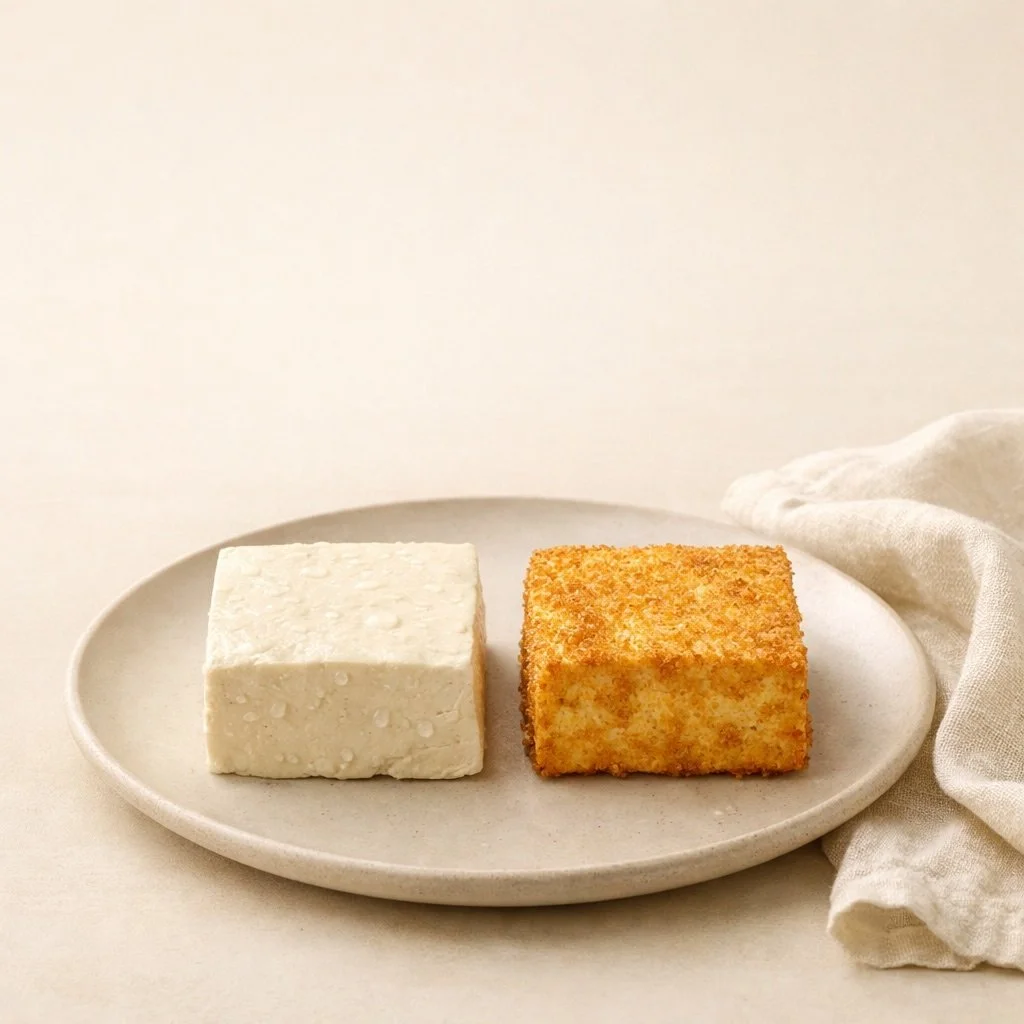
Tofu is often described as simple.
But beneath that simplicity lies a quiet complexity—one that begins with water.
Most tofu is made up of 70–90% moisture. That water is not passive. It shapes texture, controls heat, and determines whether tofu turns golden and crisp—or soft and delicate.
Moisture is not the enemy of tofu.
It is the medium through which transformation happens.
If you understand moisture, you understand tofu.
Tofu as a Protein-Water System
At its core, tofu is a protein-water gel.
Soy proteins form a delicate network that holds water in different ways:
Free water – loosely held, easy to remove
Entrapped water – held within the structure
Bound water – chemically linked to proteins
Cooking tofu is not just about heat or seasoning.
It is about guiding how water moves through this structure.
Every technique—pressing, frying, freezing—works by redistributing moisture.
The Hidden Barrier to Browning
One of the most common frustrations in tofu cooking is this:
You place tofu in a hot pan…
And it refuses to brown.
The reason is simple.
As long as water remains on the surface, the temperature is capped at 100°C due to evaporation. This creates a thermal stall.
But browning—the Maillard reaction—only begins above 140–165°C.
So the surface must dry first.
Until then, the tofu is not frying.
It is steaming.
What Happens When Moisture Is Reduced
Once excess surface water is removed, everything changes:
The temperature rises beyond the evaporation limit
Proteins and sugars begin to react
A golden crust forms
The structure becomes firmer and more defined
This is the moment tofu transforms.
From soft and neutral
To crisp, savoury, and deeply satisfying
Techniques That Shape Moisture
Different techniques don’t just prepare tofu—they reshape it.
1. Pressing – Densifying the Structure
Pressing removes free water.
Increases protein density
Improves structural strength
Prevents crumbling during cooking
Even 15–30 minutes can significantly change how tofu behaves under heat.
2. Surface Drying – Unlocking Heat
Drying the surface is essential for browning.
Pat dry with a clean cloth or paper towel
Allow brief air exposure
Avoid overcrowding in the pan
Without this step, heat energy is spent evaporating water—not building flavour.
3. Freezing – Engineering Texture
Freezing transforms tofu from within.
As water expands into ice, it reshapes the internal network.
After thawing:
The structure becomes porous and sponge-like
The texture turns chewier
Liquid absorption increases dramatically
This is not just preparation.
It is structural engineering.
4. Salt-Boiling – Gentle Moisture Adjustment
Simmering tofu in lightly salted water (around 2%) subtly shifts its structure.
Draws out excess moisture through osmosis
Tightens surface proteins
Improves resilience during cooking
A quiet technique—but a powerful one.
Moisture and Flavour: Creating Space for Absorption
Tofu does not simply “soak up flavour”.
Water content determines how flavour moves.
High moisture → diluted flavour pathways
Reduced moisture → increased absorption capacity
When excess water is removed, space is created within the structure.
This allows marinades, sauces, and oils to penetrate more effectively.
Flavour is not just added.
It is enabled by moisture control.
Matching Moisture to the Dish
There is no single ideal state of tofu.
Moisture is not a flaw to eliminate.
It is a variable to control.
Crispy pan-fried tofu → low moisture, well-pressed
Stir-fries → moderate moisture for balance
Soups and braises → higher moisture for tenderness
Desserts (silken tofu) → maximum moisture for smoothness
In some dishes, removing water creates structure.
In others, preserving it creates softness and delicacy.
The goal is not dryness.
It is alignment.
Common Failures Are Moisture Mismatches
Many tofu frustrations come down to this:
Skipping pressing → weak structure
Not drying the surface → no browning
Overcrowding the pan → trapped steam
Using silken tofu for frying → structural mismatch
These are not cooking mistakes.
They are mismatches between moisture and method.
A Shift in Perspective
Once you see tofu this way, everything changes.
You stop asking:
“How long should I cook this?”
And begin asking:
“What is the moisture doing right now?”
That question brings clarity.
And with clarity comes control.
Closing Reflection
Tofu does not resist cooking.
It responds to it.
Water is the medium through which that response happens.
By learning to guide moisture—removing it, redistributing it, or preserving it—you begin to shape texture, flavour, and structure with intention.
Not by forcing outcomes
But by working with the material itself
And in that quiet understanding, something shifts.
Cooking becomes less about instruction
And more about awareness
A small change in perspective
That leads to better meals
And a more thoughtful way of eating
One meal at a time 🌱
