
Nori-Wrapped Tofu Japanese Curry
How to Use This Dish
This is a flexible cooking framework rather than a fixed recipe.
The vegetables and curry base can change, but the structure should remain: prepare the curry first, wrap broad sections of tofu in nori, let the nori soften, slice the wrapped tofu, pan-fry the exposed faces, then serve the slices partly above the sauce.
That sequence preserves the contrast that defines the dish: tender tofu, lightly toasted nori, glossy curry and soft rice.
Dish Identity
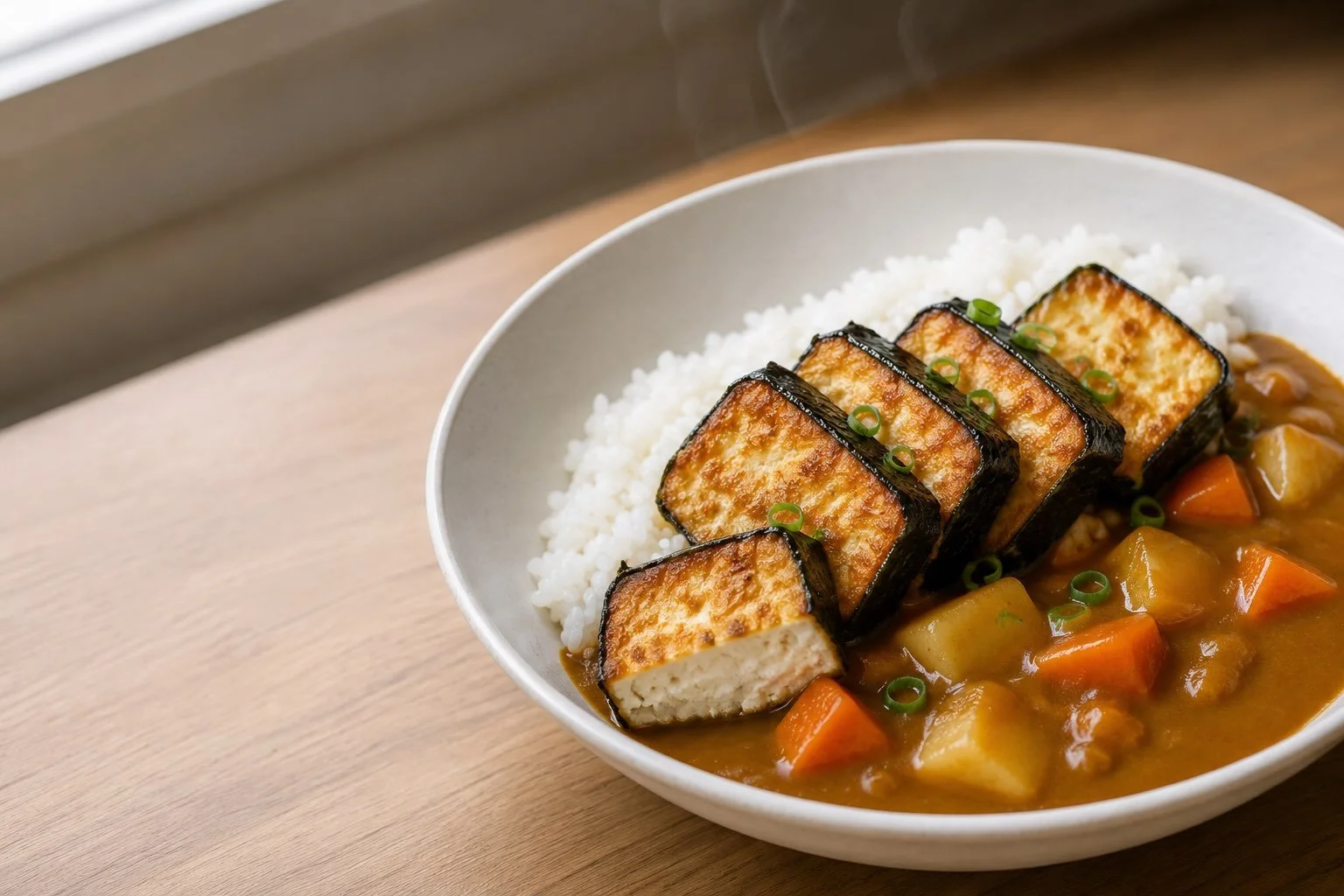
Nori-wrapped tofu Japanese curry is a mild, rounded vegetable curry served with pan-fried tofu slices framed by a thin dark edge of nori.
The tofu is not simmered inside the sauce or used to imitate meat. It remains visible and texturally distinct, giving the bowl its main character.
Each slice should have a golden surface, a moist pale centre and a narrow nori border. The curry should be smooth and flowing, with tender onion, carrot and potato supporting rather than covering the tofu.
The result is warm, balanced and quietly savoury.
Culinary Roots and Modern Context
Japanese curry is known for its gentle spice, rounded sweetness and thickened sauce, commonly served with rice and vegetables.
The nori-wrapped tofu also echoes Japanese isobe-style preparations, where nori is paired with foods such as mochi, fish cakes or tofu before grilling or frying. This is a modern curry interpretation rather than a traditional named dish, but the flavour logic is familiar: mild soy, roasted seaweed and controlled heat.
Ingredient Logic
For four servings, use 400–450 g firm tofu. Firm tofu is sturdy enough to wrap and slice while remaining tender after frying. Extra-firm tofu is easier to handle, but it can become dry if pressed or cooked too aggressively.
Cut the tofu into broad, compact sections roughly 5 cm across. Exact dimensions are less important than consistency. Each section should be large enough to produce substantial slices after wrapping.
Use plain toasted nori rather than seasoned snack nori. Cut it into strips wide enough to wrap once around each tofu section. A single layer gives a clean edge; several layers may become chewy.
For the curry, onion provides sweetness and depth. Cook it until fully softened and at least lightly golden. Continue until more deeply browned for a richer result, but avoid scorching.
Carrot adds sweetness and colour. Potato gives body and substance. Waxy or all-purpose potatoes hold their shape most reliably, while flourier varieties soften more and need gentler handling.
Commercial Japanese curry roux gives the most predictable result. Begin with 500–650 mL water or mild vegetable stock, or follow the packet quantity for four servings. Start lower and add more hot water only as needed.
A very light coating of potato starch on the exposed tofu faces is optional. It helps create delicate browning without hiding the contrast between tofu and nori.
What Success Looks Like
The tofu should be golden on both broad faces, tender inside and easy to lift without breaking.
The nori should cling closely, with a few natural wrinkles rather than looking rigid. It should taste lightly toasted, not burnt or leathery.
The curry should coat the vegetables and settle around the rice without becoming watery or paste-like. The tofu should sit partly above the sauce so its browned surfaces remain visible.
Cooking Logic
Build the curry first
Cook one sliced onion in a modest amount of neutral oil over medium heat until soft and golden. Add one or two carrots and two medium potatoes, cut into substantial pieces, and cook for several minutes.
Add the lower end of the liquid range and simmer gently until the vegetables are almost tender.
Reduce the heat before adding the curry roux. Break it into smaller pieces or dissolve it in a ladleful of hot cooking liquid before returning it to the saucepan. Stir over low heat until the sauce becomes smooth and glossy.
If it is too thick, add hot water gradually. If it is too thin, simmer briefly without the lid. Keep the curry warm over very low heat.
Wrap and rest the tofu
Drain the tofu and pat it dry. Press only briefly if it is unusually wet; the centre should remain moist.
Wrap each broad section in one snug layer of nori. Position the overlap along one side rather than across a face that will touch the pan.
The tofu’s surface moisture should begin softening the nori. If the final edge will not stick, touch it with a slightly damp fingertip.
Rest the wrapped tofu seam-side down for several minutes. This gives the nori time to soften, conform and hold its shape.
Slice cleanly
Using a very sharp, thin-bladed knife, cut the wrapped tofu crosswise into slices about 1 cm thick.
Use a smooth, decisive motion rather than pressing or sawing. Wipe the blade between cuts. If the nori starts to drag, lightly dampen the blade, then remove any visible water before slicing again.
Handle the slices by their broad faces rather than pinching the nori edge.
Pan-fry gently
Lightly blot the exposed tofu faces. Dust them sparingly with potato starch if using, keeping most of it away from the nori.
Heat a thin layer of neutral oil in a wide pan over medium heat. Arrange the slices in a single layer and leave them undisturbed until the first side becomes golden.
Turn with a thin spatula and brown the second side.
Moderate heat matters. High heat can scorch the nori before the tofu colours. Remove the slices once both faces are golden and the centres are heated through.
Plate with contrast
Place steamed Japanese short-grain rice on one side of a shallow bowl and spoon the curry beside it.
Arrange the tofu where the rice and curry meet, allowing only part of each slice to touch the sauce. This keeps the browned surfaces visible while allowing every bite to combine tofu, nori, curry and rice.
Finish with only a light scattering of spring onion.
Why the Wrap Works
Dry nori becomes flexible when it absorbs a small amount of moisture from the tofu. Resting allows that moisture to spread, helping the sheet follow the tofu’s shape before slicing.
Pan-frying then removes moisture from the exposed nori edge, firming it slightly and strengthening its roasted aroma.
Too little moisture leaves the nori brittle. Too much makes it fragile and slippery. The goal is controlled softening, not soaking.
Adaptation and Troubleshooting
Mushrooms, pumpkin, peas or green beans can be added, but limit the curry to one or two extra vegetables so its flavour remains clear.
If the nori cracks, it may be stale or wrapped too tightly. If it opens, rest the wrapped tofu longer and secure the final edge with minimal moisture.
If the tofu stays pale, dry the faces more thoroughly and avoid crowding the pan. If the nori burns, reduce the heat.
A watery curry usually begins with too much liquid. A gluey curry usually contains too much roux or has reduced too far. Correct either gradually rather than making a large adjustment at once.
Closing Reflection 🌱
This dish gives tofu and nori a shared structure.
The tofu provides tenderness and substance. The nori follows its shape and becomes a fine roasted edge. The curry supports both with warmth, sweetness and body without hiding them.
Tofu does not need to imitate meat or disappear beneath stronger flavours. When its texture is understood, and its role is clear, it becomes the unmistakable centre of the meal.
