
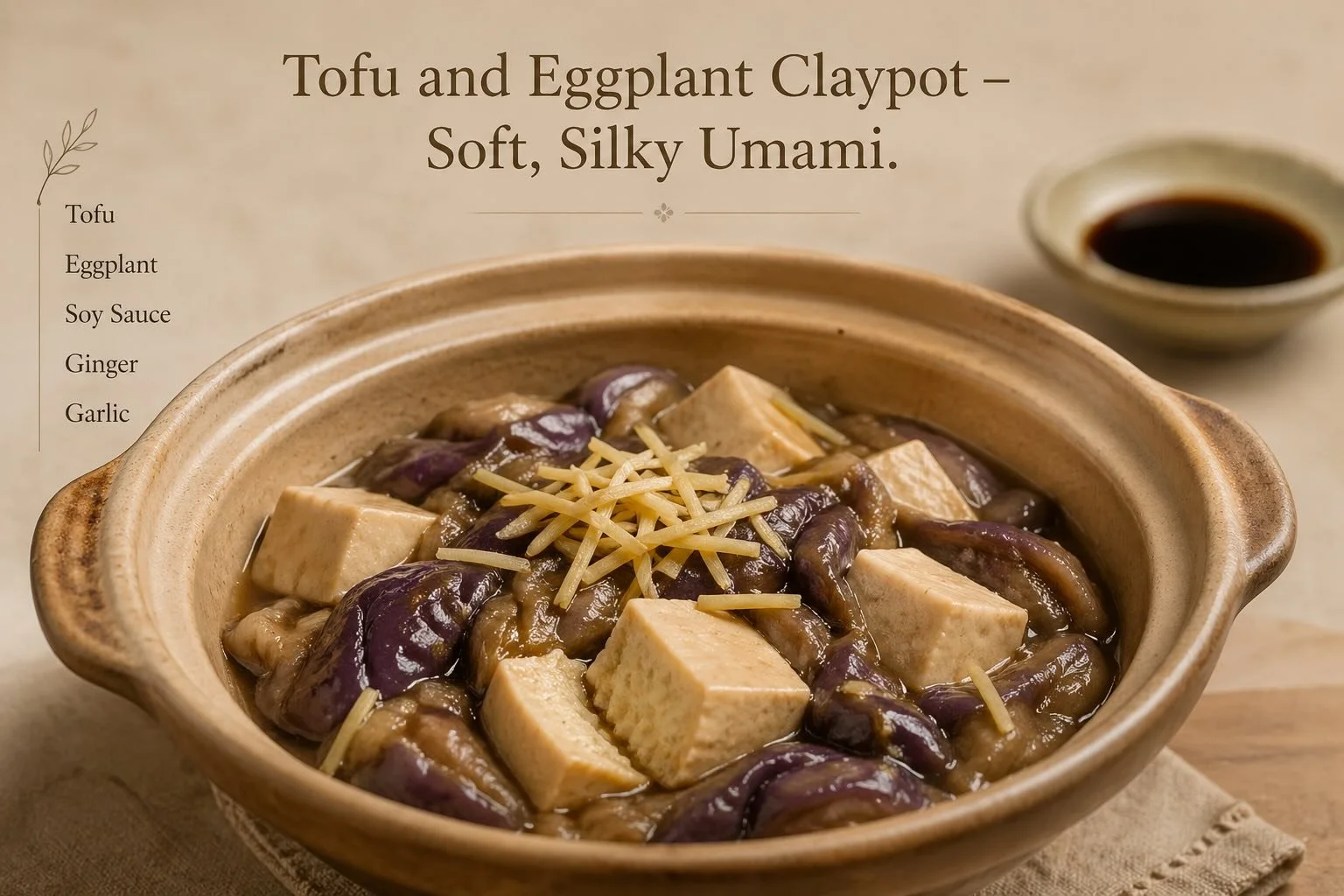
Tofu and Eggplant Claypot – Soft, Silky, Deep Umami
How to Use This Dish
This is not a fixed recipe. It’s a structure.
Once you understand how tofu and eggplant behave under heat — how they soften, absorb, and carry flavour — you can adjust everything around them.
Different sauces, different aromatics, different finishes.
The foundation remains the same.
Dish Identity (What This Is About)
This dish is built on texture harmony and quiet umami.
Tofu → soft, delicate, custard-like
Eggplant → silky, collapsed, oil-free richness
Sauce → light, savoury, gently reduced
It is not heavy.
It is not aggressively seasoned.
The goal is a coated, cohesive claypot, not a flooded stew.
Ingredient Logic
Each element has a role.
Structure (Protein Base)
Firm or medium tofu
→ Holds shape while remaining soft inside
Silk (Vegetable Body)
Eggplant
→ Breaks down into a silky texture, acting almost like a natural sauce
Depth (Umami Layer)
Light soy sauce
Mushroom-based stock or water
→ Builds savoury depth without heaviness
Aroma (Finish)
Ginger
Garlic
→ Lifts the dish at the final stage
Balance (Optional Brightness)
A few drops of sesame oil or rice vinegar
→ Adds subtle contrast and direction
Structural Goal (What Success Looks Like)
Eggplant fully softened, almost melting
Tofu intact but delicate
Sauce lightly coats every surface
No excess liquid pooling at the base
A gentle, savoury aroma — not overpowering
The dish should feel warm, calm, and complete.
Core Technique (The System Behind It)
1. Prepare the Eggplant (Control Moisture First)
Cut eggplant into chunks or strips.
Cook in a hot pan or claypot without oil first, allowing moisture to release.
Once softened, add a small amount of water to continue cooking until silky.
→ This prevents oil saturation and builds natural richness.
2. Build the Base
Add ginger and garlic to the pan.
Let them gently release aroma — not brown aggressively.
→ This keeps the flavour clean and integrated.
3. Introduce the Liquid
Add soy sauce and a small amount of stock or water.
Simmer briefly.
→ The liquid should be just enough to coat, not stew.
4. Add the Tofu (Late Stage)
Gently place tofu into the mixture.
Do not stir aggressively.
Let it warm through and absorb surface flavour.
→ Tofu is delicate — movement breaks structure.
5. Reduce to a Coating
Let the liquid reduce slightly.
The sauce should cling lightly to eggplant and tofu.
→ This is where the dish comes together.
6. Finish
Optional: a few drops of sesame oil or a touch of acidity.
Serve immediately in a claypot or warm bowl.
Why This Works (Simple Food Science)
Eggplant behaves like a structure-breaker.
As it cooks, its cell walls collapse, releasing water and forming a silky texture.
This creates a natural binding effect — almost like a sauce without thickening agents.
Tofu, on the other hand, is a protein-water gel.
It doesn’t absorb deeply — it interacts at the surface.
That’s why:
Flavour is built in the surrounding liquid
Texture contrast is preserved
The dish feels cohesive without being heavy
Serving Suggestions
Serve with steamed rice to carry the sauce
Pair with simple greens for contrast
Eat immediately while hot — texture is at its peak
No garnish is required.
The dish is complete as it is.
Final Takeaway
This dish shows how little you actually need.
When texture is understood, when heat is controlled, when ingredients are allowed to behave as they are, flavour doesn’t need to be forced.
Tofu and eggplant don’t compete.
They soften into each other.
And in that softness, something quietly powerful appears.
A reminder that simple, plant-based cooking isn’t about limitation — it’s about clarity. 🌱
