
Tofu, Black Pepper & Soy Sauce: A Fiery Peppercorn Stir-Fry
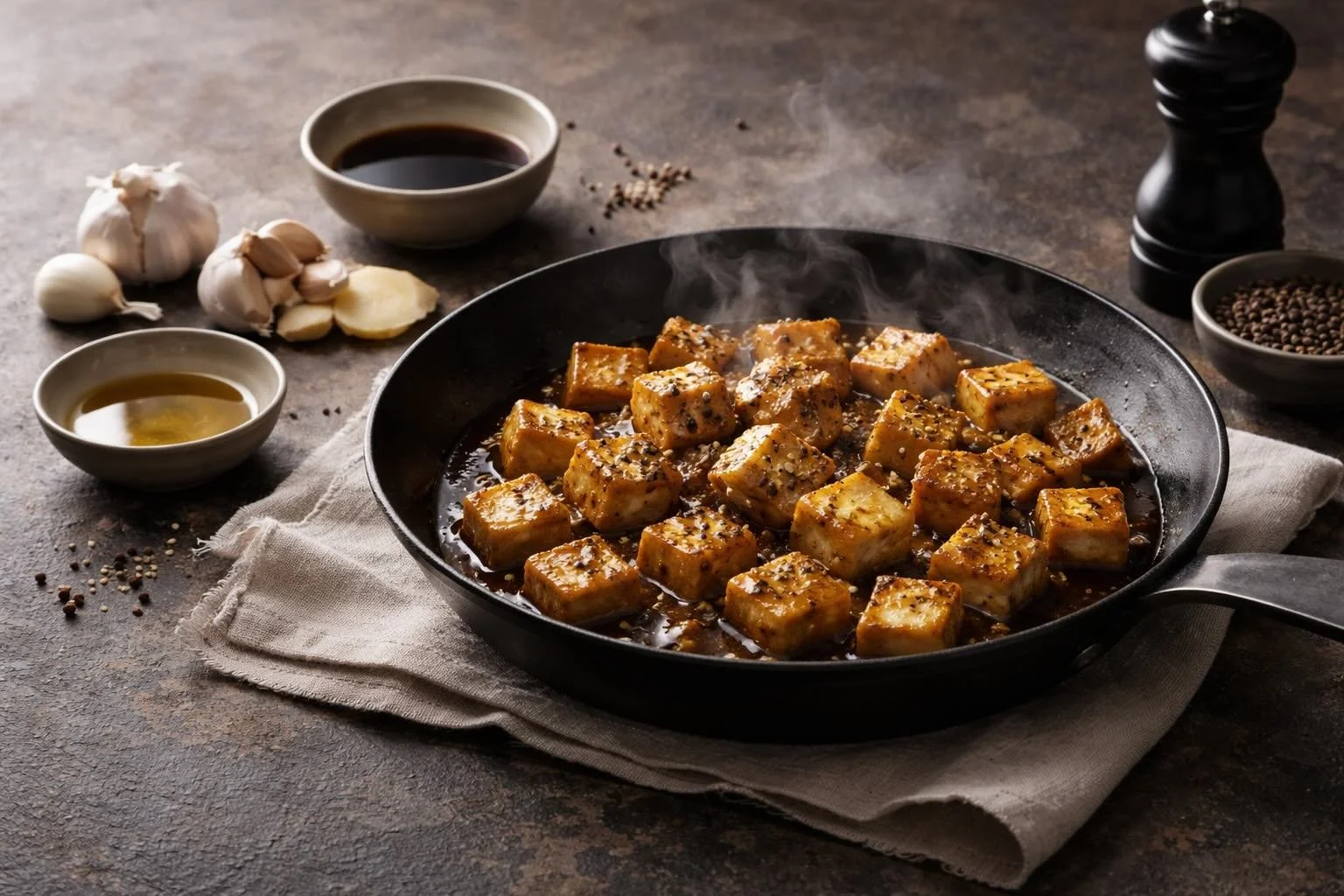
What This Dish Is About
This dish doesn’t soften itself.
It doesn’t round the edges with sweetness or lift itself with acidity.
It moves in a single direction: forward.
Soy sauce deepens.
Black pepper sharpens.
Oil carries everything across the surface.
And tofu—quiet, neutral—becomes the place where all of it lands.
How to Approach It
Start not with seasoning, but with the surface.
Tofu that holds moisture will resist change.
It will sit in the pan and gently steam, never quite becoming anything else.
But once the surface dries, something shifts.
Heat begins to build.
Edges begin to form.
And what was soft becomes structured enough to receive flavour.
Where the Flavour Begins
The first real flavour in this dish isn’t soy or pepper.
It’s the moment tofu meets heat—and is left alone.
Not stirred too early.
Not moved too often.
Because what’s forming here is not colour for appearance, but a surface that can hold and return flavour.
Without this, everything else slides off.
The Shift Into Aroma
Once that surface exists, the pan changes character.
Garlic and ginger enter—not as dominant flavours, but as something more subtle.
They dissolve into the oil.
And the oil itself becomes active—no longer just heat, but a medium that carries aroma across every piece.
When Heat Becomes Flavour
Black pepper arrives at this moment.
Not sprinkled passively, but released into heat.
Its sharpness opens up.
Its warmth spreads.
Unlike chilli, it doesn’t hit all at once.
It lingers.
Builds.
Stays.
And carried through oil, it reaches every edge of the tofu—not just sitting on top, but woven through the dish.
Where Everything Comes Together
Soy sauce enters quietly, but decisively.
Not as a marinade.
Not as a base.
As a final anchor.
It binds what’s already there:
the structure created by heat
the aroma held in oil
the sharpness of pepper
Just enough to coat.
Just enough to cling.
Too much, and the dish becomes heavy.
Too little, and it feels unfinished.
Here, it simply connects.
Texture Is Not an Afterthought
How the tofu is cut changes how this dish feels:
Smaller pieces catch more heat, more pepper, more intensity
Larger pieces hold softness inside, resisting that intensity
Rough, torn edges trap sauce and spice in ways smooth cuts cannot
This is not a presentation.
It’s how flavour attaches itself to structure.
What Makes This Dish Different
Most stir-fries are designed to balance:
sweetness against salt, acid against richness.
This one doesn’t.
It narrows its focus.
It asks:
What happens when flavour is reduced to just a few forces—and pushed with intention?
The answer is something sharper.
More immediate.
More direct.
How It Evolves (If You Let It)
You can soften it, if you choose:
Add onions or capsicum → introduce sweetness and relief
Add a splash of vinegar → bring lift and contrast
Add a touch of sugar → round the edges
But each addition changes the point of the dish.
The original version holds its line.
Cultural & Culinary Context
Across many Asian stir-fry traditions, black pepper is not secondary.
It is defined.
Not overwhelming like chilli, but precise—aromatic, sharp, and persistent.
Paired with soy sauce, it creates a flavour that is both grounded and lifted, anchored in umami but alive with heat.
This dish follows that lineage in its simplest form.
Final Takeaway 🌱
Not every dish needs to be complete in every direction.
Some are meant to be clear.
This one teaches us to recognise when enough is already there:
Heat.
Oil.
Umami.
And tofu, holding all of it without resistance.
When we understand that, we stop trying to fix the dish and start letting it speak as it is.
