
Sweet and Savoury Tofu: Peanut Butter and Maple Glaze
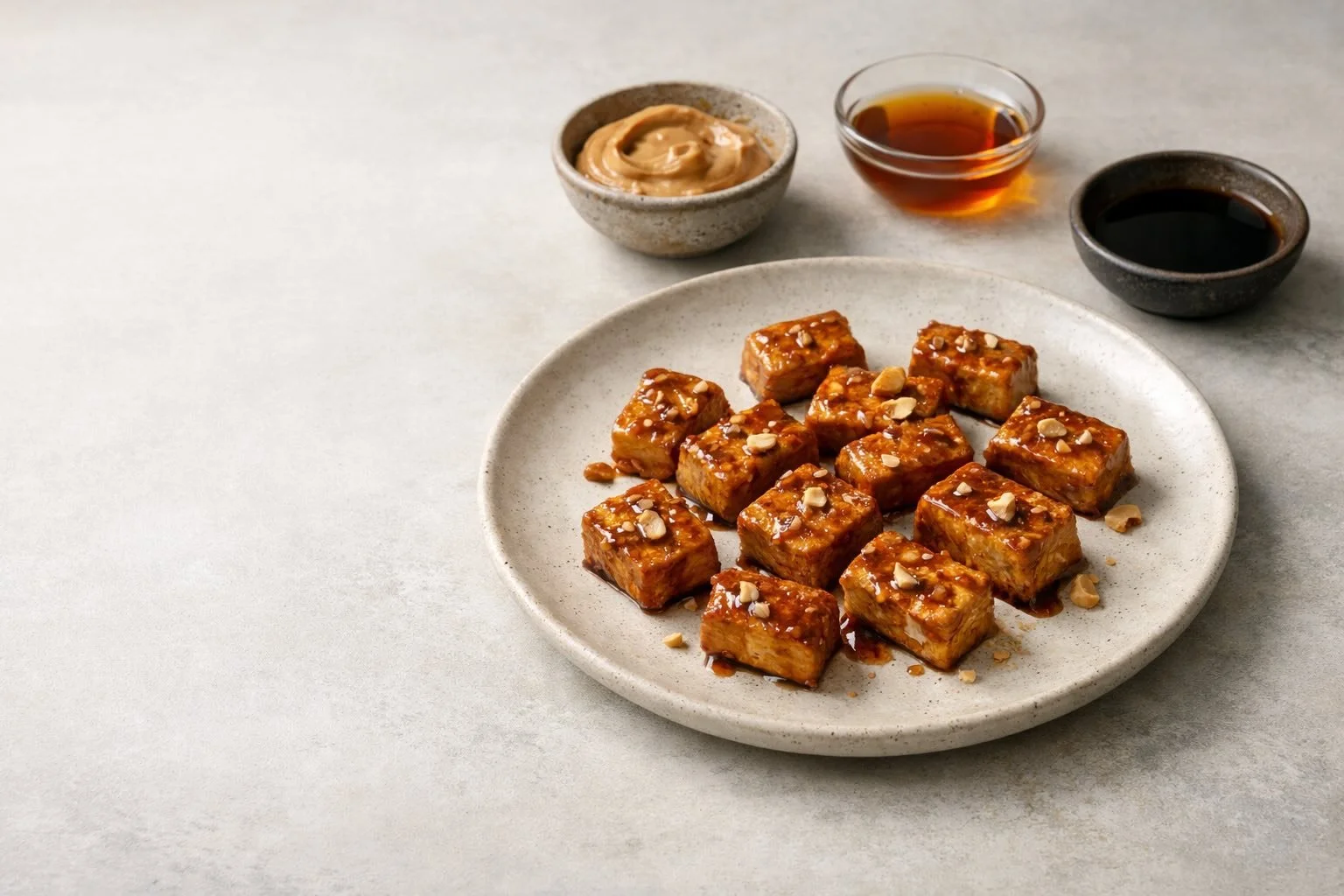
How to Use This Dish
This is not a dessert.
And it’s not quite savoury either.
It lives in the space between.
Serve it:
Over warm rice or grain bowls
With roasted vegetables or steamed greens
Wrapped in flatbread with fresh herbs
Or simply on its own, as something quiet and complete
It’s a dish that doesn’t try to impress.
It settles instead.
Dish Identity
Peanut butter and maple syrup create a glaze that is both grounding and fluid.
The peanut brings weight—fat, protein, a natural density that coats and lingers.
The maple brings movement—sweetness with a soft edge, never sharp, never aggressive.
Together, they form something balanced but not neutral.
And tofu sits in the middle of it all—not absorbing everything, but holding it at the surface, where flavour is most alive.
Cultural & Ingredient Context
This pairing doesn’t belong to one tradition.
It echoes:
Southeast Asian peanut sauces
Western nut-based dressings
Modern plant-based cooking, where sweetness is used not as contrast, but as integration
Maple syrup, often associated with desserts, plays a different role here.
It doesn’t dominate—it softens.
Peanut butter, on the other hand, acts as both flavour and structure.
This is not fusion.
It’s alignment.
Ingredient Logic (Roles, Not Just Ingredients)
Tofu (Primary Structure)
Firm or medium tofu works best. It provides a stable surface that can carry the glaze without breaking.Peanut Butter (Depth + Carry)
Acts as both a flavour base and a lipid carrier. It holds aromatic compounds and creates a thick, coating texture.Maple Syrup (Sweetness + Balance)
Adds warmth and rounds out the savoury elements. It softens salt and enhances the perception of richness.Soy Sauce (Umami + Salt)
Grounds the glaze. Without it, the dish drifts too far into sweetness.Garlic / Ginger (Aromatics)
Provide lift and direction. They cut through the density of the peanut base.Acid (Optional Brightness)
A small amount of rice vinegar or lime juice can be added to lift the glaze and lighten its richness.
This is optional—not required—but it brings clarity if the dish feels heavy.Water or Plant Milk (Adjustment)
Loosens the glaze to the right consistency—coating, not clumping.
Method (A Framework, Not a Recipe)
1. Prepare the tofu
Cut or tear into bite-sized pieces.
If you want:
Crisp edges → pat dry and pan-sear
Soft texture → use as is, gently warmed
The structure you choose sets the tone.
2. Build the glaze
In a bowl, combine:
Peanut butter
Maple syrup
Soy sauce
Minced garlic or grated ginger
If you’re unsure where to start:
begin with roughly equal parts peanut butter and liquid, then adjust gradually.
Add water or plant milk a little at a time until the glaze becomes smooth and pourable.
You’re not aiming for thickness—you’re aiming for flow.
3. Heat and integrate
Warm the glaze gently in a pan.
Add the tofu and turn to coat.
Let it sit briefly in the heat—not to reduce aggressively, but to allow the glaze to settle and cling.
The oil in the peanut butter will begin to shine.
That’s when it’s ready.
4. Balance
Taste, then adjust:
A touch more soy → if it feels flat
A touch more maple → if it feels too sharp
A small amount of acid → if it feels heavy
A splash of water → if it feels too dense
Balance is not fixed.
It’s responsive.
Texture & Flavour Notes
The glaze should coat, not drown
The tofu should hold its shape, not collapse
The flavour should feel continuous, not separated into sweet vs savoury
This is not contrast cooking.
This is convergence.
Pairing Ideas
Steamed broccoli or bok choy → for contrast and freshness
Brown rice or quinoa → to absorb excess glaze
Chilli oil or flakes → if you want a sharper edge
Fresh herbs (coriander, mint) → to lift the richness
Final Takeaway 🌱
Some dishes are built on contrast.
This one is built on agreement.
Peanut, maple, soy—none of them competes.
They settle into each other.
And tofu doesn’t try to transform them.
It simply holds the moment where they meet—steady, quiet, and complete.
