
How to Cook Without Oil – The System Behind Flavour
Why Oil Feels Essential
Oil appears in almost every cooking method.
Not because it is irreplaceable—but because it quietly performs multiple roles at once.
It spreads heat.
It carries flavour.
It reduces sticking.
When it’s removed, cooking feels harder—not because something is missing, but because those roles are no longer hidden.
What Oil Actually Does
Oil is not flavour itself.
It is a medium.
It performs three functions:
Heat transfer → helping energy move evenly across a surface
Flavour transport → dissolving and spreading fat-soluble compounds
Surface control → reducing friction and managing sticking
Once you see this, the question changes:
Not “What replaces oil?”
But “How do these roles still happen?”
The System Shift
Removing oil doesn’t remove these functions.
It redistributes them:
Heat is carried by direct contact, steam, or air
Flavour moves through water, salt, and natural plant fats
Surface control comes from dryness, timing, and material choice
Cooking becomes less about adding and more about controlling conditions.
Principle 1: Moisture Sets the Limit
The biggest misconception in cooking is that oil creates browning.
It doesn’t.
Water prevents it.
As long as surface moisture exists, temperature is capped at around 100°C due to evaporation.
This is the thermal limit of wet cooking.
Only when the surface dries can the temperature rise, and browning begins.
What this changes
Drying becomes a primary step, not an afterthought
Spacing matters more than coating
Time replaces force
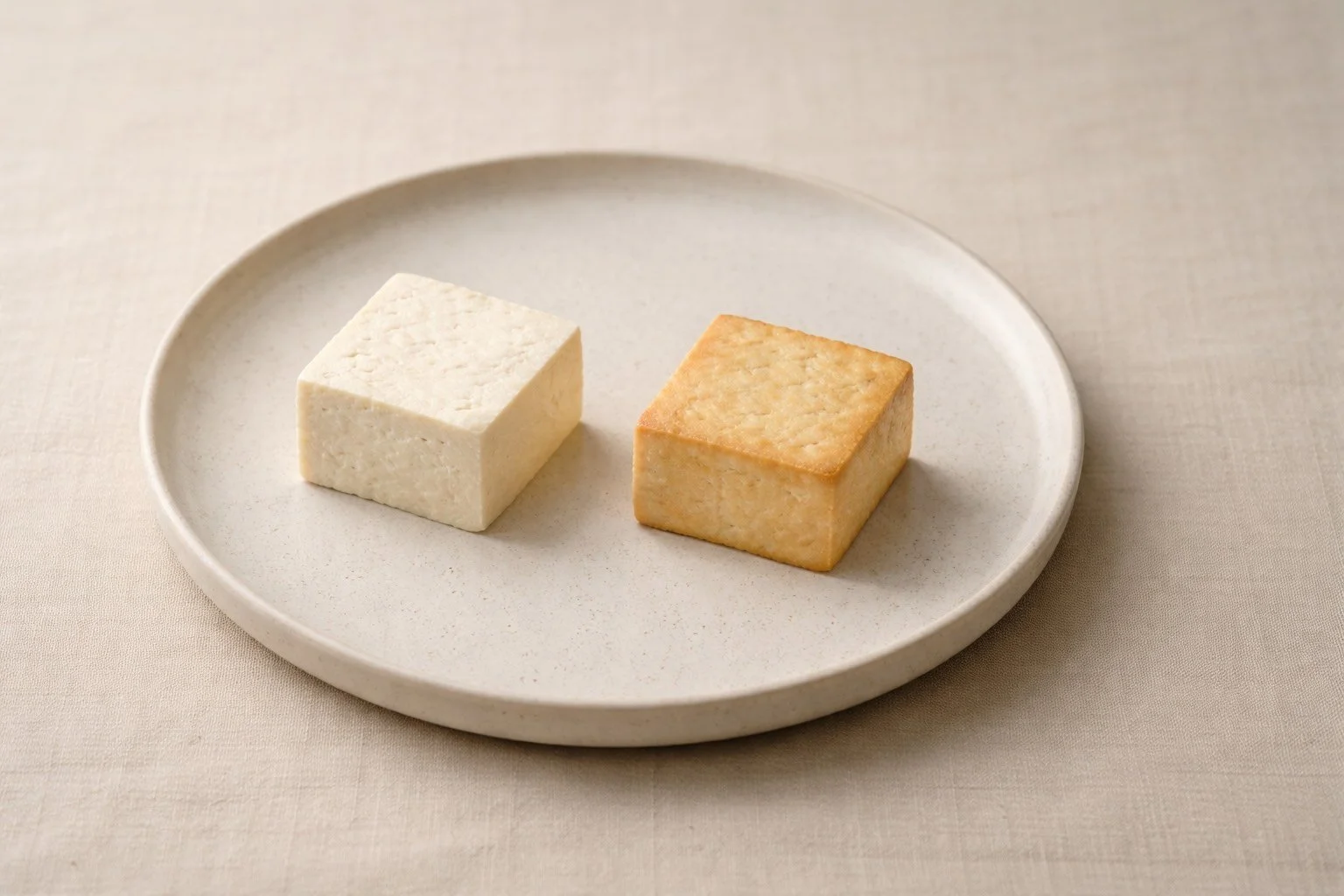
Tofu makes this visible immediately.
A wet surface resists change.
A dry surface transforms.
Principle 2: Heat Requires Contact
Oil acts as a thermal bridge between the pan and the food.
Without it, heat transfer becomes less forgiving—because air interrupts contact and acts as an insulator.
This changes how you cook:
The pan becomes the primary heat carrier
Contact must be intentional and stable
Movement is reduced
What this changes
You stop tossing constantly.
You place the ingredient.
You allow the surface to set.
You wait for structure to form.
Tofu responds clearly to this.
Once contact stabilises, it releases naturally.
Principle 3: Flavour Moves in Two Systems
Flavour does not depend on oil.
But it does depend on how it moves.
There are two primary systems:
Water-based movement → carries salt and water-soluble compounds
Fat-based movement → carries aromatic, fat-soluble compounds
Oil is one way to deliver fat-based flavour.
But it is not the only way.
Whole plant fats—like tahini, nuts, or coconut—perform the same role, while contributing their own flavour.
What this changes
Broth becomes a primary tool, not a backup
Salt becomes more important for depth
Timing determines how far flavour travels
Tofu, as a protein–water gel, doesn’t absorb like a sponge, but under heat, its structure relaxes enough for flavour to integrate.
Principle 4: Structure Creates Texture
Without oil, you can’t rely on smoothness.
You rely on structure instead.
Rough edges increase surface area
Thin sections dry faster
Irregular shapes create variation
What this changes
Texture becomes something you design.
Tearing tofu instead of slicing it creates jagged surfaces—increasing drying efficiency and forming small crevices that hold sauce more effectively.
Principle 5: Richness Is Chosen, Not Default
Removing oil does not remove richness.
It changes its source.
Plants already contain fats and flavour systems:
Tahini
Nuts and seeds
Coconut
Miso
Gochujang
These provide both:
flavour
and the fat needed to carry it
What this changes
You stop adding fat automatically.
You start choosing it deliberately.
Cultural Context
Cooking without oil is not a modern idea.
Many traditional systems rely on:
water-based cooking
broth and fermentation
minimal use of added fats
Buddhist cuisine—particularly Shojin Ryori—emphasises clarity, restraint, and ingredient integrity over heavy lipid use.
What feels restrictive today is often a return to older logic.
Final Takeaway 🌱
Oil simplifies cooking.
But understanding clarifies it.
When you remove oil, you begin to see:
How moisture controls temperature.
How contact determines heat.
How flavour moves through different systems.
And tofu—quiet, neutral, responsive—reveals all of it.
You don’t need to replace oil.
You need to understand what it was doing.
Because once you do, you’re no longer cooking without oil.
You’re cooking with awareness.
