
How Packaged Tofu Is Made – From Factory to Fridge
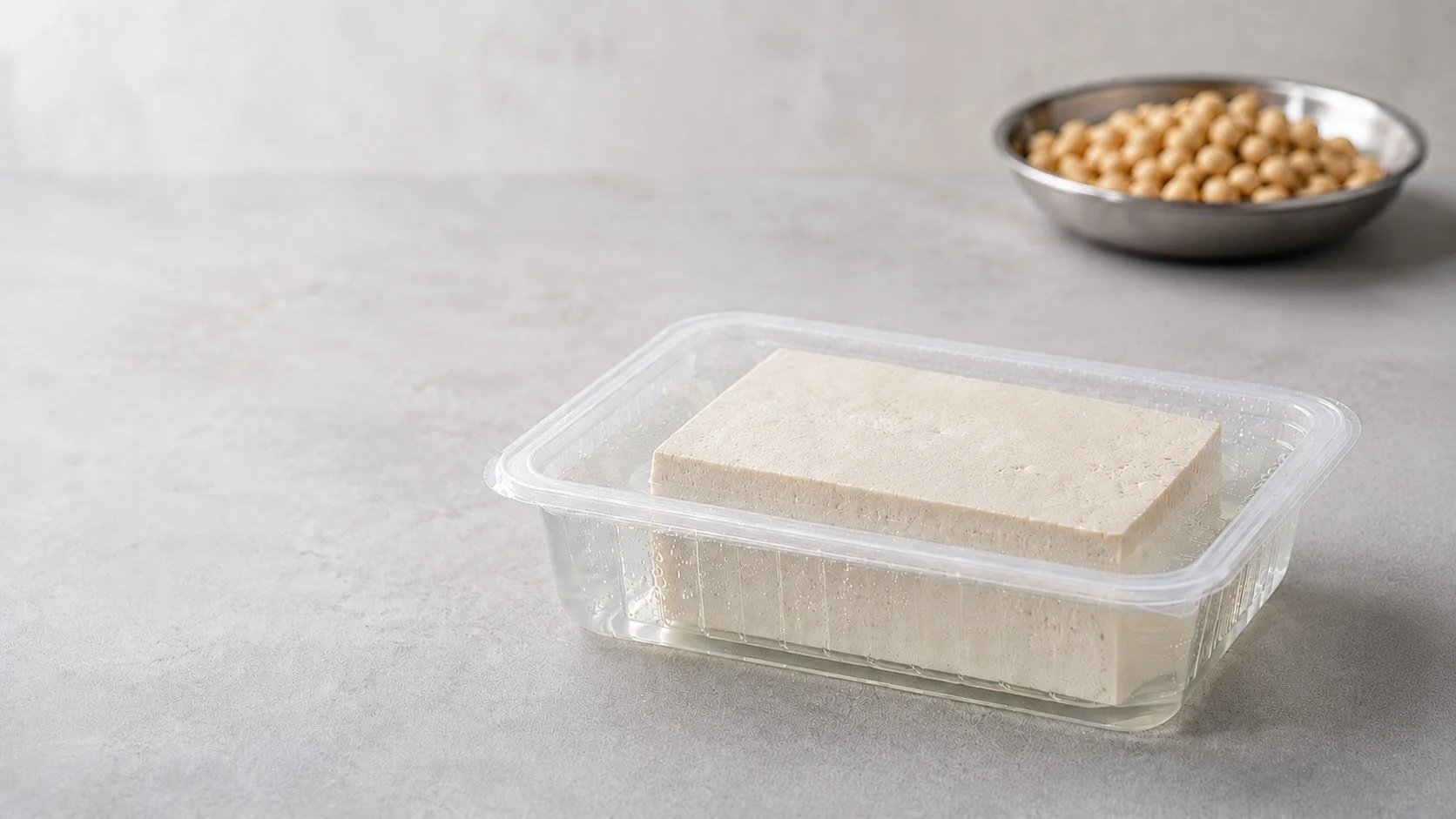
A sealed block of tofu may look simple, but producing it consistently requires careful control of water, heat, protein, minerals, pressure and hygiene.
The basic principle is ancient: extract soy milk, coagulate its proteins and shape the resulting curds. Modern factories scale up that craft with stainless-steel equipment, temperature monitoring and food-safety controls. Methods vary between manufacturers and tofu styles, but most refrigerated block tofu follows the same journey.
1. Selecting and Cleaning the Soybeans
Tofu begins with mature, dried soybeans. Manufacturers choose varieties partly for their protein content and processing performance because not every soybean produces the same yield, flavour or texture.
The beans are cleaned to remove dust, stones, damaged beans and other foreign material. Some factories also remove the hulls. Dehulling can produce a paler, smoother soy milk and reduce some unwanted flavours, although it is not essential to every process.
Quality control begins here. Bean variety, age, storage conditions and moisture content can all influence the finished tofu.
2. Soaking the Beans
Clean soybeans are soaked in water until they absorb moisture and soften. Hydration allows them to be ground efficiently and helps their proteins disperse into the liquid.
Soaking time depends on water temperature, bean condition and the manufacturer’s process. Warmer water generally accelerates hydration, but time and temperature must be controlled carefully. Excessively long or poorly managed soaking can encourage microbial growth or affect flavour and yield.
The swollen beans are then drained and rinsed before grinding.
3. Grinding with Water
The hydrated soybeans are ground with water to create a pale slurry. This mixture contains water, soybean proteins, oils, carbohydrates and fine particles of fibre.
The ratio of beans to water matters. More water generally produces a more dilute soy milk, while less water creates a higher concentration of solids. Manufacturers adjust this balance according to the tofu they intend to make.
Grinding must be sufficiently fine to release useful protein and oil, but it also needs to remain compatible with efficient filtration.
4. Heating the Soy Slurry
The soybean slurry is heated either before or after its liquid is separated from the pulp, depending on the production system.
Heating serves several purposes. It cooks the raw soybean mixture, inactivates much of the trypsin-inhibitor activity that can interfere with protein digestion, reduces raw “beany” flavours and unfolds soy proteins so they can later form a gel.
This stage requires precision. Insufficient heating can leave undesirable flavours and underprocessed proteins, while excessive heating may alter coagulation behaviour and reduce product quality.
5. Separating Soy Milk from Okara
The cooked or partially cooked slurry is filtered or mechanically separated into two streams:
liquid soy milk, which becomes tofu;
moist soybean pulp, known as okara.
Okara still contains fibre, protein and other nutrients. Depending on the factory and local market, it may be used in food products, animal feed, compost, fermentation or other applications. Finding higher-value uses for okara is an important opportunity to reduce waste in tofu manufacturing.
The extracted soy milk is not usually the beverage-style soy milk sold for drinking. It is formulated for tofu production, with its concentration closely managed to achieve the required yield and structure.
6. Coagulating the Soy Milk
Coagulation is the defining transformation.
The hot soy milk is combined with a coagulant such as calcium sulphate, magnesium chloride, calcium chloride or glucono delta-lactone. Each works somewhat differently, but all help destabilise the suspended soy proteins so they can associate into a continuous network that traps water and oil.
Temperature, soy-milk concentration, coagulant type, dosage and mixing technique all affect the result. Too little coagulant may create weak curds; too much can produce a coarse texture or mineral taste. Aggressive mixing may break the forming structure, while inadequate distribution can cause uneven setting.
After gentle mixing, the soy milk rests while curds form.
7. Shaping the Tofu
For conventional firm and extra-firm tofu, the curds and whey are transferred into cloth-lined moulds. Pressure removes some of the liquid and brings the curds together into a cohesive block.
Pressing time and pressure help determine the final texture. Removing more water generally creates a denser, firmer tofu, but firmness is not controlled by pressing alone. Soy-milk solids, heating history, coagulant and curd handling also matter.
Soft tofu may be pressed lightly or handled with less curd disturbance. Silken tofu commonly follows another route: soy milk and coagulant are filled into containers and allowed to set as one continuous, delicate gel rather than being broken into curds and pressed.
8. Cutting, Cooling and Packaging
Pressed tofu is removed from its mould, cut into retail-sized blocks and cooled. Depending on the factory, blocks may be washed or cooled in clean water before packaging.
Many refrigerated products are sealed with water inside a plastic tub or pouch. The water protects the tofu from drying and cushions its delicate surface; it is not necessarily evidence that the block is “watered down”.
Some tofu is sealed first and then heat-treated in its package. Other products pass through different pasteurisation or hygienic-filling systems. There is no single packaging sequence used by every manufacturer.
Shelf-stable tofu requires specialised processing and packaging designed to prevent recontamination. It should not be confused with ordinary refrigerated tofu simply packed in a similar-looking carton.
9. Food Safety and the Cold Chain
Tofu is moist, nutrient-rich and generally not highly acidic, so refrigerated varieties can support microbial growth if mishandled. Factories therefore control sanitation, heating, cooling, packaging integrity and storage temperature.
Sealed packs are inspected for correct weight, leaks, damaged seals and contamination. Labels provide ingredient, allergen, date and storage information. Because tofu contains soy, this must also be clearly declared as an allergen.
Refrigerated tofu must remain cold during storage, transport and retail display. Once it reaches your fridge, follow the package directions, use it by the stated date and refrigerate any opened portion promptly in a clean, covered container.
Final Takeaway
Packaged tofu is not merely soy milk pressed into a block. Its texture and quality emerge from a connected sequence: soybean selection, hydration, grinding, heating, filtration, protein coagulation, shaping, packaging and temperature control.
Small changes anywhere along that sequence can produce tofu that is silken or firm, delicate or dense. Modern equipment makes the process consistent and safe, but the essential transformation remains remarkably traditional: coaxing soybean proteins into a nourishing food with water, minerals, heat and care.
