
The Soul of Tofu: Lessons in Meaningful Change
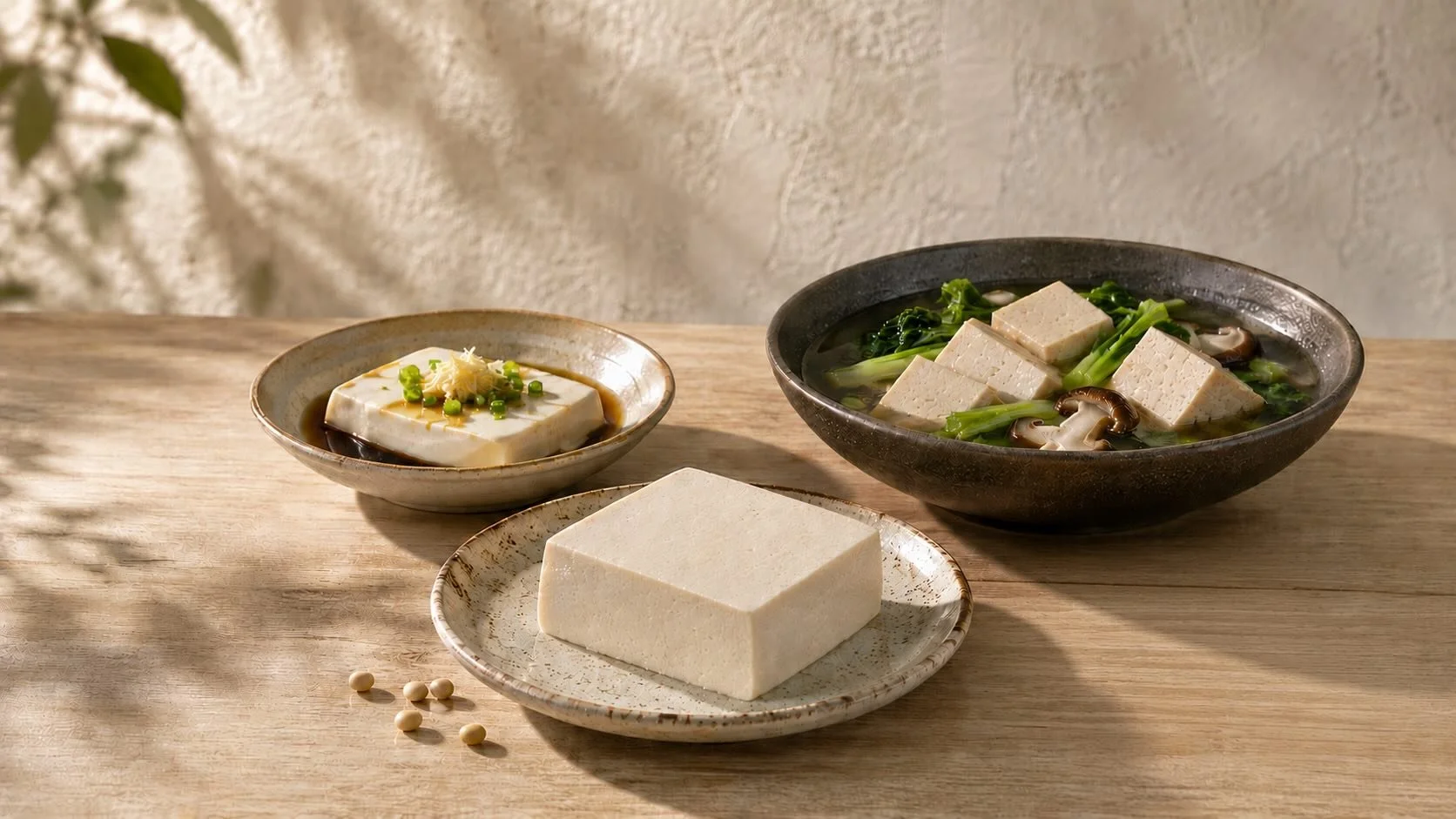
At first glance, tofu can seem remarkably simple: pale, quiet and restrained. Yet its simplicity is not emptiness. It is possibility.
Within one block lies a history shaped by ingenuity and a structure transformed by water, heat and coagulants. Tofu can quiver beneath a spoon, hold its shape in broth or develop a golden crust. Different conditions reveal different qualities within it.
That makes tofu a fitting symbol of change. It does not gain value by pretending to be something else. Knowledge, care and circumstance help it become more fully itself.
From Soybean to Tofu
Tofu originated in China, although its exact beginnings remain uncertain. Some traditions trace it to the Han dynasty, but no single inventor or moment of discovery has been established.
In conventional tofu-making, soybeans are soaked, ground with water and processed to obtain a protein-rich soy liquid. Heat unfolds some of its proteins, and a coagulant helps them form a gel that holds water and fat.
Calcium sulphate, or gypsum, often produces smooth, cohesive curds. Magnesium chloride-rich nigari acts more rapidly and can create a more pronounced curd, while glucono delta-lactone (GDL) gradually acidifies soy milk and is widely used for uniform silken tofu. Final texture also depends on soy concentration, temperature, mixing and pressing. The gel may remain delicate and unpressed or form curds pressed into firmer blocks.
Lesson from tofu: Transformation does not always require becoming something different. Sometimes it begins with the right conditions for new qualities to emerge.
Adaptability Without Losing Identity
Tofu is often called a blank canvas or a sponge for flavour. There is some truth in that description, but it oversimplifies how tofu behaves.
Dense firm tofu does not automatically draw a marinade deep into its centre. Seasoning remains mainly near its surface, edges and pores. Tearing creates more surface area; freezing opens its structure; and searing gives glazes and oils a browned surface to cling to.
The cook does not simply add flavour to tofu; the cook works with its structure.
Nor does tofu disappear into every dish. In mapo doufu, tender tofu contrasts with chilli oil, fermented bean paste and Sichuan pepper. Japanese hiyayakko celebrates chilled tofu's clean flavour, while Korean dubu-jorim braises pan-fried slices.
Each preparation transforms tofu, but tofu also shapes the dish.
Lesson from tofu: Adaptability is not the same as erasure. We can respond to our surroundings while retaining a character of our own.
Many Textures, Different Purposes
There is no single ideal tofu texture. Each style offers different possibilities.
Silken tofu holds abundant water within a fragile gel. Its appeal lies in its smoothness; pressing would destroy the quality that makes it special.
Firm tofu has a stronger network and can be sliced, torn, seared, grilled or simmered. Removing surface moisture can improve browning, although dense vacuum-packed tofu may need little or no pressing.
Freezing changes tofu again. Ice crystals disrupt its protein network, leaving it open, springy and better able to hold broth. Pressed and smoked tofu, along with fermented tofu products, offer still more possibilities.
When tofu disappoints, the ingredient may not be the problem. Its variety, technique and culinary role may simply be mismatched.
Silken tofu will not behave like extra-firm tofu in a frying pan, while a subtle fresh tofu may be overwhelmed by a heavy glaze.
Better tofu cooking begins with a more useful question—not “How do I make tofu taste like something else?” but “What does this tofu do well?”
Transformation Requires the Right Conditions
Heat, water and time can each reveal something different in tofu.
A dry, hot surface encourages browning. Gentle heat protects tenderness. Simmering carries broth into exposed spaces. Freezing changes texture, while pressing increases density.
More force is not always better. Excessive pressing can dry firm tofu, high heat can burn a sugary glaze, and rough handling can reduce silken tofu to fragments.
Successful transformation comes from understanding what the ingredient needs. Beyond the kitchen, lasting change may likewise need patience and support rather than pressure alone.
One Thoughtful Choice
Tofu can support a broader shift towards more sustainable eating. Compared with many animal proteins—particularly beef—soy foods generally require less land and produce fewer greenhouse-gas emissions. Their impacts still vary with farming, processing, packaging and transport, so tofu is not environmentally weightless.
Choosing it need not be all or nothing. One household might cook tofu weekly; another might replace part of the meat in a familiar meal. Change becomes meaningful when it is realistic enough to repeat.
Tofu is not merely a modern substitute designed to imitate meat. It is a longstanding food with its own traditions, flavours and techniques.
Try One Small Transformation
Choose a tofu style you rarely use and give it a role suited to its structure:
Serve silken tofu chilled with ginger, spring onion and a restrained dressing.
Sear firm tofu until broad golden patches form before applying a glaze.
Freeze and thaw a block, then simmer it gently in mushroom broth.
Notice what changes and what remains: a crisp surface around a tender centre, or broth entering spaces opened by freezing. Attention makes tofu's metaphor tangible.
Final Takeaway
The soul of tofu is not that it can become anything. It is that one humble ingredient can take many forms without losing its identity.
Its journey from soybean to delicate gel, pressed block or broth-filled piece shows transformation as a relationship between potential and circumstance, guided by knowledge, patience and care.
In the kitchen, that understanding helps us choose and cook tofu more skilfully. Beyond it, tofu offers a quieter lesson: meaningful change can begin with curiosity, develop through practice and become lasting through repetition—one meal and one thoughtful choice at a time.
