
Fragile to Flavourful: Tofu Skin (Yuba) in Modern Cuisine
What Is Tofu Skin (Yuba), Really?
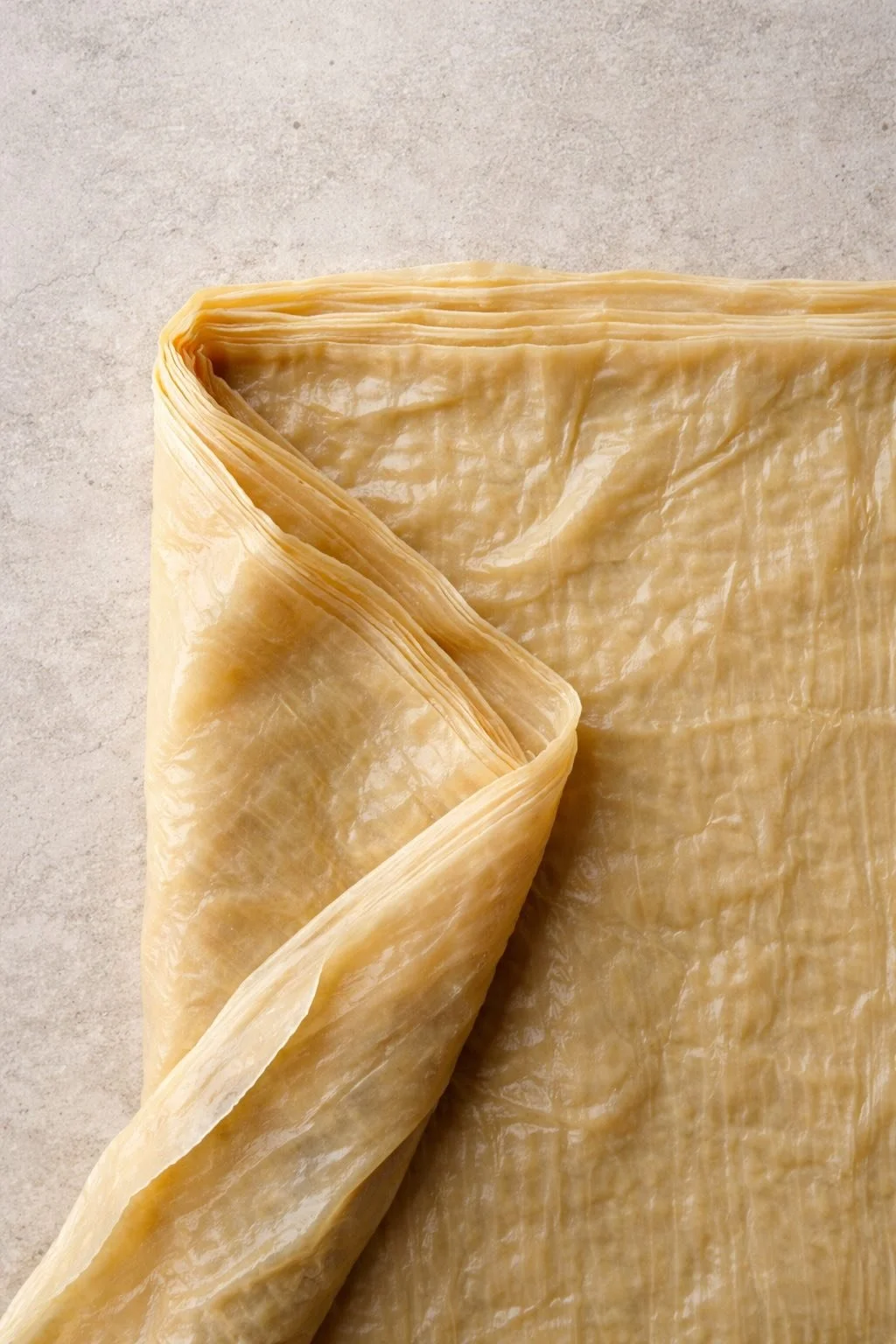
Tofu skin—known as yuba—is not a type of tofu at all. It forms naturally on the surface of heated soy milk as proteins and lipids bond at the air–liquid interface. This creates a thin, layered film that can be lifted, dried, folded, or rolled.
Unlike tofu’s hydrated gel structure, yuba is a dense, non-porous film—not a sponge.
It has no porous interior.
It doesn’t absorb marinades the way pressed tofu does.
Instead, yuba holds flavour through surface adhesion and structure—a detail that explains both its delicacy and its strength.
This distinction is the key to cooking yuba well.
Why Yuba Has a Reputation for Being “Difficult”
Yuba’s reputation comes from misunderstanding, not fragility.
Most failures fall into two categories:
Too much water → gummy or slippery texture
Too fast (before full relaxation) → brittle, tearing, or cracking
Because yuba is layered rather than porous, aggressive soaking overwhelms its protein–lipid structure, while insufficient hydration leaves it inflexible.
Handled gently, yuba becomes neither fragile nor fussy—it becomes precise.
How Yuba Transforms with Proper Hydration
Hydration is not about saturation—it’s about relaxation.
When soaked gradually in warm (not hot) water, yuba softens evenly. The layers loosen without dissolving. What emerges is a pliable sheet that bends, wraps, and folds with intention.
At this stage, yuba behaves less like tofu and more like fresh pasta or rice paper:
Flexible but structured
Neutral but responsive
Light yet resilient
This makes it ideal for modern plant-based cooking where texture matters as much as flavour.
How Yuba Carries Flavour (Without Absorbing It)
One of the most important truths about yuba is this:
Yuba does not absorb flavour—it captures it.
Flavour clings to yuba through:
Oil-based coatings
Seasoned surfaces
Crisped edges and folds
This is why yuba shines when pan-seared, roasted, or layered. Browning creates contrast. Folding creates pockets. Surface area becomes the flavour engine.
Trying to “marinate” yuba deeply often disappoints—but seasoning it intelligently delivers elegance.
Yuba in Modern Cuisine: Beyond Tradition
Traditionally used in East Asian cooking, yuba has found a new voice in modern kitchens.
Today, it appears as:
Crisp shards for salads and grain bowls
Rolled wraps replacing pastry or rice paper
Layered folds mimicking pasta sheets
Textural accents in refined plant-based dishes
Chefs value yuba not because it imitates meat, but because it offers something meat cannot: lightness without emptiness.
It delivers structure without heaviness.
Presence without dominance.
Common Mistakes to Avoid
Even confident cooks trip up with yuba. Here’s what usually goes wrong:
Boiling water soaking → outer layers gelatinise
Over-handling while dry → cracking and splits
Treating it like tofu → soggy or underwhelming results
Yuba asks for patience, not force.
Once understood, it becomes one of the most forgiving ingredients on the plate.
Why Yuba Fits the Future of Plant-Based Cooking
Yuba represents a quieter kind of innovation.
It’s low-waste.
It’s minimally processed.
It’s protein-rich without being heavy.
In a food culture moving toward restraint, clarity, and texture-first design, tofu skin feels perfectly timed.
It reminds us that plant-based cooking doesn’t need louder flavours—just better understanding.
Final Takeaway
Yuba isn’t fragile.
It’s honest.
Treat it with care, and it transforms from a delicate sheet into a confident, flavour-holding structure that elevates modern plant-based cooking.
In a world chasing shortcuts, yuba rewards attention—and proves that the most understated ingredients often have the most to say.
From fragile to flavourful—this is tofu skin at its best. 🌱✨
