
Why “Bean Curd” and “Tofu” Sound So Different to Us
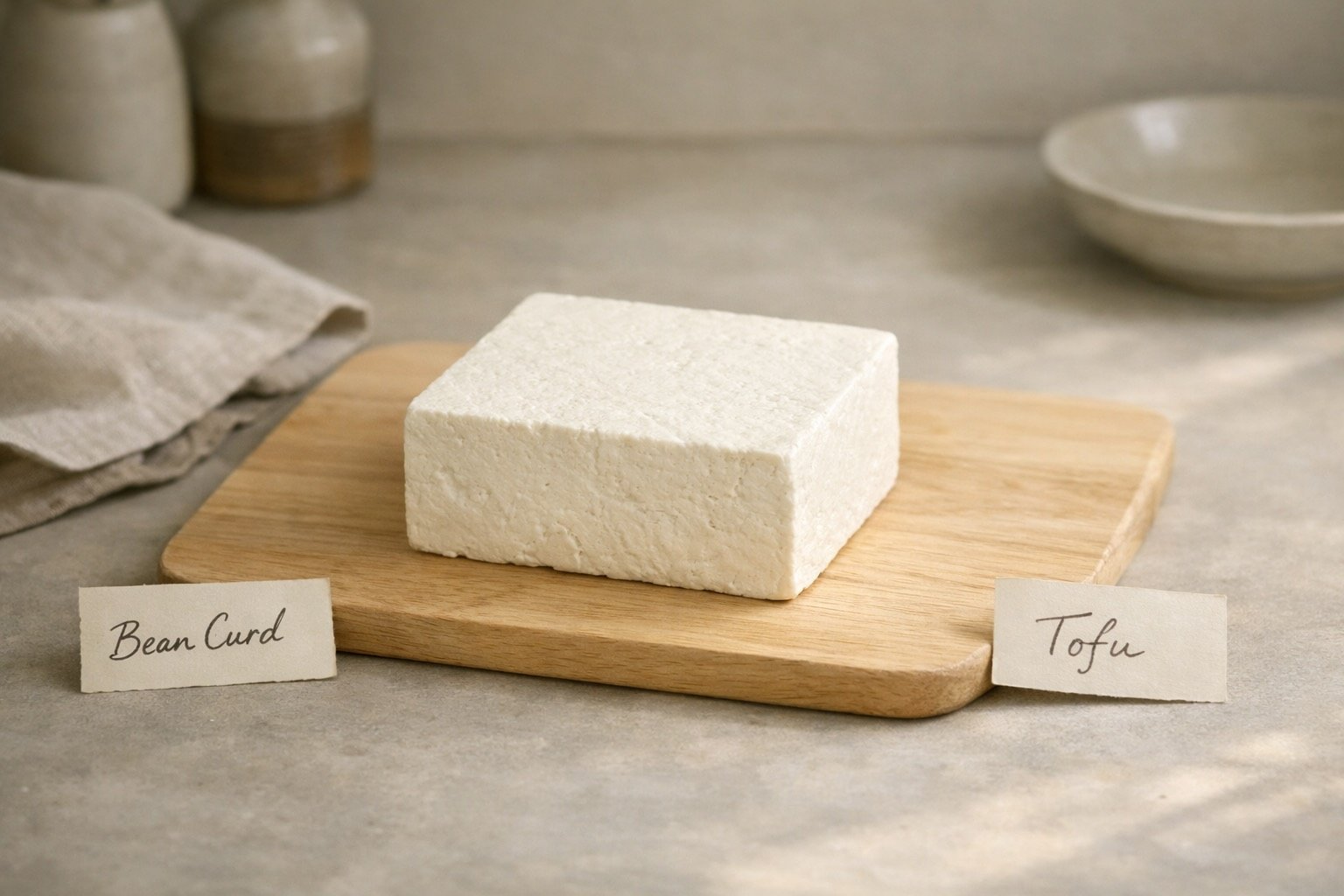
The Curious Case of Two Names, One Food
At a technical level, bean curd and tofu can refer to the same food: soy milk that has been coagulated and set into a delicate protein gel. The ingredients are the same. The basic process is the same.
Yet to many English-speaking ears, bean curd can sound heavy, old-fashioned, or slightly unappetising, while tofu feels cleaner, calmer, and more inviting.
Why?
The answer has surprisingly little to do with food science.
It lies in language, history, and the way words shape our expectations of food.
What “Bean Curd” Actually Means
The name bean curd is a direct English description.
Bean refers to soybeans.
Curd refers to the coagulated solids that form when proteins set.
Technically, the name is accurate. Bean curd is a curd, much as cheese begins as a dairy curd.
The challenge is not accuracy but association.
For many English speakers, the word curd can suggest cottage cheese, sour milk, separation, or something that has broken apart rather than something carefully crafted. Even lemon curd, delicious though it is, still sounds thick, rich, and old-fashioned.
So when tofu is called bean curd, some people may unconsciously judge it before tasting it.
Why “Tofu” Feels Different
The word tofu ultimately comes from the Chinese word dòufu (豆腐), which entered modern English largely through the Japanese pronunciation tōfu.
Interestingly, dòufu is also a literal name. The character dòu means bean, while fǔ points to a curdled or transformed food. But most English speakers do not hear that literal meaning. They simply hear the name tofu.
That difference matters.
Unlike bean curd, tofu is experienced in English as a loanword rather than a description.
Loanwords often allow foods to establish their own identity. We say sushi, kimchi, miso, ramen, and tempeh instead of translating them into technical English. Their names invite curiosity instead of explaining exactly how they are made.
Tofu benefits in the same way.
Rather than drawing attention to coagulation or production, the word simply identifies a food with its own traditions, textures, and possibilities.
A Question of Cultural Context
Across East Asia, tofu has long been valued as an ingredient in its own right.
It appears in humble family meals, refined banquet dishes, Buddhist temple cooking, comforting soups, delicate steamed dishes, and boldly flavoured braises.
It has also been used creatively in vegetarian and temple cuisines to echo the textures or forms of meat. That history matters because it shows tofu has never been limited to a single role. It can be delicate and plain, deeply savoury, luxurious, comforting, or playful.
When tofu became better known in many Western countries, however, it entered food cultures where meat often occupied the centre of the plate. Plant proteins were frequently introduced as alternatives or substitutes rather than as ingredients with their own culinary traditions.
Within that context, the name bean curd could make tofu sound like a processed bean product rather than a crafted ingredient with its own culinary logic.
Language Shapes Appetite
Words do more than describe food.
They influence what we expect before the first bite.
Compare these two menu descriptions:
Stir-fried bean curd
Crisp golden tofu
The dish could be identical, yet many readers imagine it differently.
Bean curd tends to draw attention to how the food is made.
Tofu draws attention to the ingredient itself.
To many English speakers, one sounds technical, while the other feels like a complete food with its own identity.
That subtle difference can shape curiosity, expectation, and even appetite.
Why “Bean Curd” Became Less Common
English usage has moved between phonetic names and descriptive names for centuries. Older writings used spellings such as teu fu, tau-fu, and tofu, while later English sources also used descriptive names such as bean curd, soybean curd, and bean cheese.
These names reflected different ways of introducing an unfamiliar food to English-speaking readers.
As Chinese, Japanese, Korean, Vietnamese, and other Asian cuisines became more familiar internationally, keeping original food names also became more common.
During the 1970s, growing interest in Japanese cuisine, macrobiotic cooking, vegetarian food, and influential books such as The Book of Tofu helped establish tofu as the preferred English name.
Today, tofu appears on supermarket shelves, restaurant menus, and cookbooks around the world.
But bean curd has not disappeared, and it is not wrong.
You may still see it in older cookbooks, traditional restaurant translations, and parts of Australia, New Zealand, and the United Kingdom. In Asian supermarkets and restaurants, bean curd may also refer to related soy foods such as bean curd skin, dried bean curd sticks, fried bean curd puffs, or fermented bean curd.
That distinction is useful to know.
In everyday modern English, tofu usually means the fresh block: silken, soft, medium, firm, or extra firm. Bean curd may mean the same thing, but it can also refer to a wider family of soy-based products.
Same Food, Different Future
Tofu does not need to pretend to be meat.
It does not need to apologise for being made from soybeans.
And it does not need to be understood only through how it is produced.
It is tofu: silky, soft, firm, extra firm, fried, grilled, braised, steamed, chilled, fermented, and endlessly versatile.
Using the word tofu encourages us to see it as generations of cooks have seen it: not as a compromise, but as an ingredient with history, character, and possibility.
That shift in perspective matters if we want a kinder and more sustainable food culture.
The Tofu World Takeaway 🌱
Sometimes, changing how we eat begins with changing how we speak.
The words we choose shape how we think about food long before it reaches the plate.
When we call tofu by the name that has travelled with it across cultures, we make room to appreciate it for what it is: not a compromise, not an imitation, but one of the world's most versatile ingredients.
Let's keep tofu as tofu.
