
Cooking Without Recipes (Part 2): Training Your Senses
Series: Cooking Without Recipes
A practical guide to developing kitchen intuition — learning to notice change, trust your senses, and build flavour with confidence using tofu as a training ingredient.
Articles in this series
• Cooking Without Recipes (Part 1): Developing Kitchen Intuition
• Cooking Without Recipes (Part 2): Training Your Senses
• Cooking Without Recipes (Part 3): Cooking With Confidence
• How to Layer Flavours Like a Chef — No Recipe Required
Intuition Lives in the Senses
In Part 1, we began with attention — learning to pause and notice ingredients before acting.
But attention alone isn’t enough.
To cook without recipes, you must also learn how to recognise the signals ingredients give while they change. Heat, moisture, and time constantly reshape what happens in the pan, and those changes reveal themselves through the senses.
Intuition isn’t guesswork.
It is the ability to see, hear, smell, and feel what food is doing.
And once again, tofu proves to be a remarkably patient teacher.
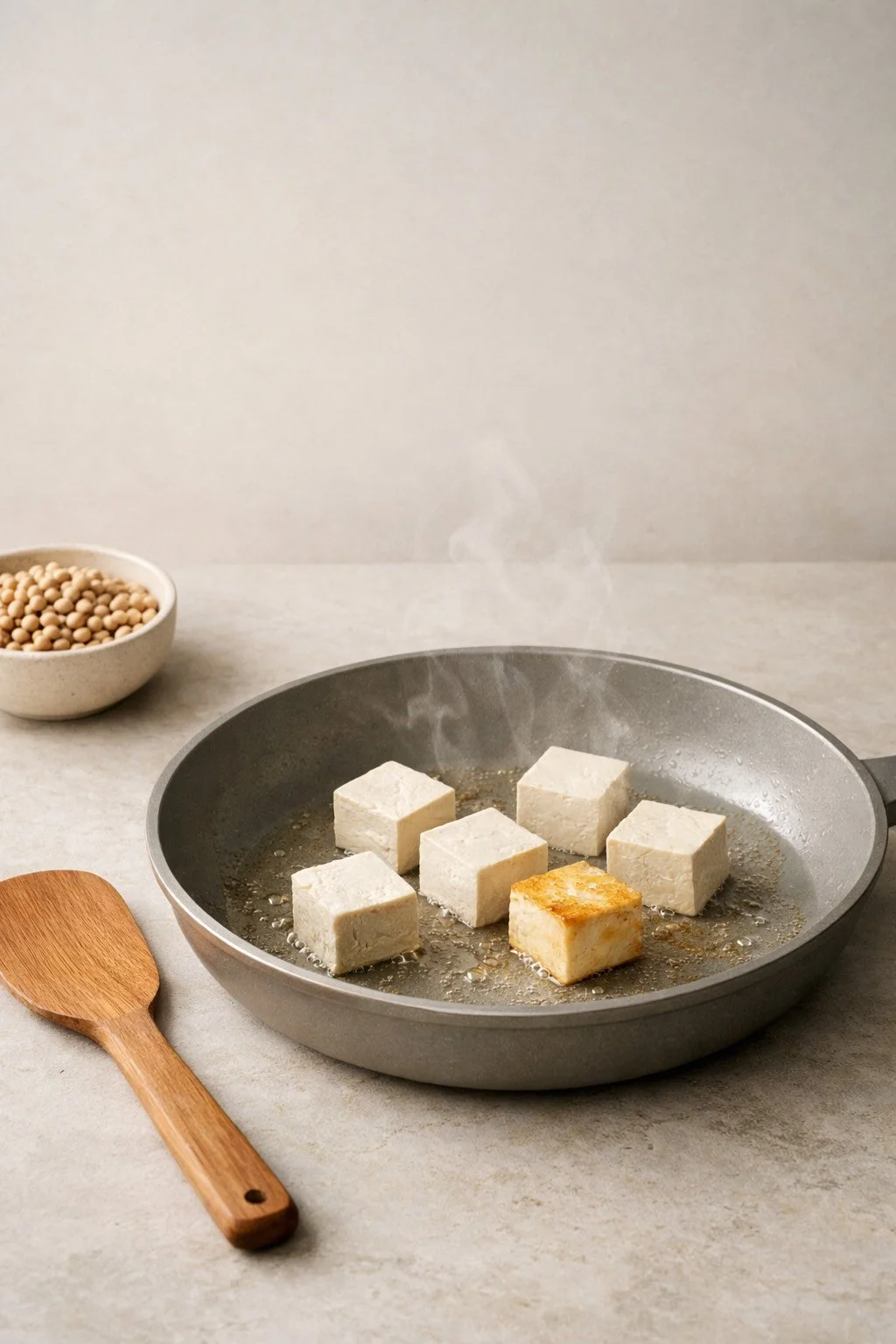
Because it has a mild flavour and calm cooking behaviour, its changes are easy to observe. Nothing dramatic distracts you. Every small shift becomes visible.
That makes tofu one of the best ingredients for learning how to read the kitchen.
Sight: Learning to Read Change
Before anything smells different or tastes finished, it looks different.
Tofu reveals this clearly.
As it cooks, subtle visual transitions begin to appear:
• Surface moisture slowly evaporates
• The exterior shifts from matte to lightly glossy
• Edges soften, then gradually firm
• Colour deepens almost imperceptibly
Nothing happens suddenly.
Instead, the ingredient moves through stages.
When you begin noticing those stages, a small but powerful shift occurs. Instead of asking:
“Is it done yet?”
You begin asking:
“What stage is it in?”
That question turns cooking from a countdown into observation.
Sound: The Language of the Pan
Sound is one of the most underused senses in cooking.
Yet it often reveals change faster than sight.
Tofu makes this especially clear.
When tofu first enters a hot pan, moisture meets heat and produces an irregular hiss. As water slowly evaporates, that sound becomes steadier — a calm, consistent sizzle.
You may notice:
• Loud spluttering when moisture first hits the oil
• A steady sizzle as evaporation stabilises
• Quiet patches when the tofu loses contact with the pan
These changes tell you something about heat, moisture, and contact.
You don’t need to understand the physics immediately.
You only need to notice when the sound changes.
Once you begin listening, cooking feels far less mysterious.
Smell: Timing Without Clocks
Smell often acts as an early signal.
With tofu, aroma develops gradually:
• At first, almost neutral
• Then a warm, grain-like scent as moisture lifts
• Finally, a subtle nuttiness as surfaces begin to brown
These aromatic shifts happen before visual browning becomes obvious.
This is why experienced cooks often adjust heat or movement before a timer ends. Their noses recognise the stage.
Recipes try to replace this awareness with minutes and seconds.
But the senses can tell you far more precisely what the food is actually doing.
Touch: Trusting Your Hands
Touch may be the most powerful sense in intuitive cooking.
Tofu makes tactile learning safe and clear.
Press a cube gently with a spatula or fingertip, and you may feel the structure changing:
• Soft surfaces becoming resilient
• Fragile edges beginning to hold shape
• Loose curds tightening into cohesion
These changes cannot be measured with numbers.
They are felt.
Over time, your hands begin recognising these signals almost instantly. What once required checking becomes quiet understanding.
Why Tofu Accelerates Learning
Many ingredients hide their signals behind strong flavour or dramatic reactions.
Tofu does the opposite.
Its behaviour is slow enough to observe and forgiving enough to experiment with.
It is also:
• Pre-cooked and safe to taste
• Structurally responsive to heat
• Affordable enough for experimentation
Because mistakes are low-risk, attention becomes easier.
And attention is what allows sensory learning to happen.
The Goal Isn’t Precision — It’s Awareness
Training your senses does not make cooking rigid.
It makes it responsive.
You begin noticing things like:
• When something needs more time
• When it needs less movement
• When heat should rise or fall
• When an ingredient is ready to rest
And you notice these signals without being told.
That quiet awareness is intuition beginning to form.
What Comes Next
Sensing change is only part of the process.
At some point, awareness must turn into action.
In Part 3, we move from observation to decision — learning how to adjust heat, timing, and seasoning with confidence, even without a recipe.
Final Takeaway
Your senses already understand far more about cooking than you might realise.
They simply need space to work.
Tofu provides that space — calm, neutral, and responsive enough for every signal to become visible.
And once you begin listening, intuition stops feeling mysterious.
It starts feeling natural. 🌱
➡ Continue reading:
Cooking Without Recipes (Part 3): Cooking With Confidence
